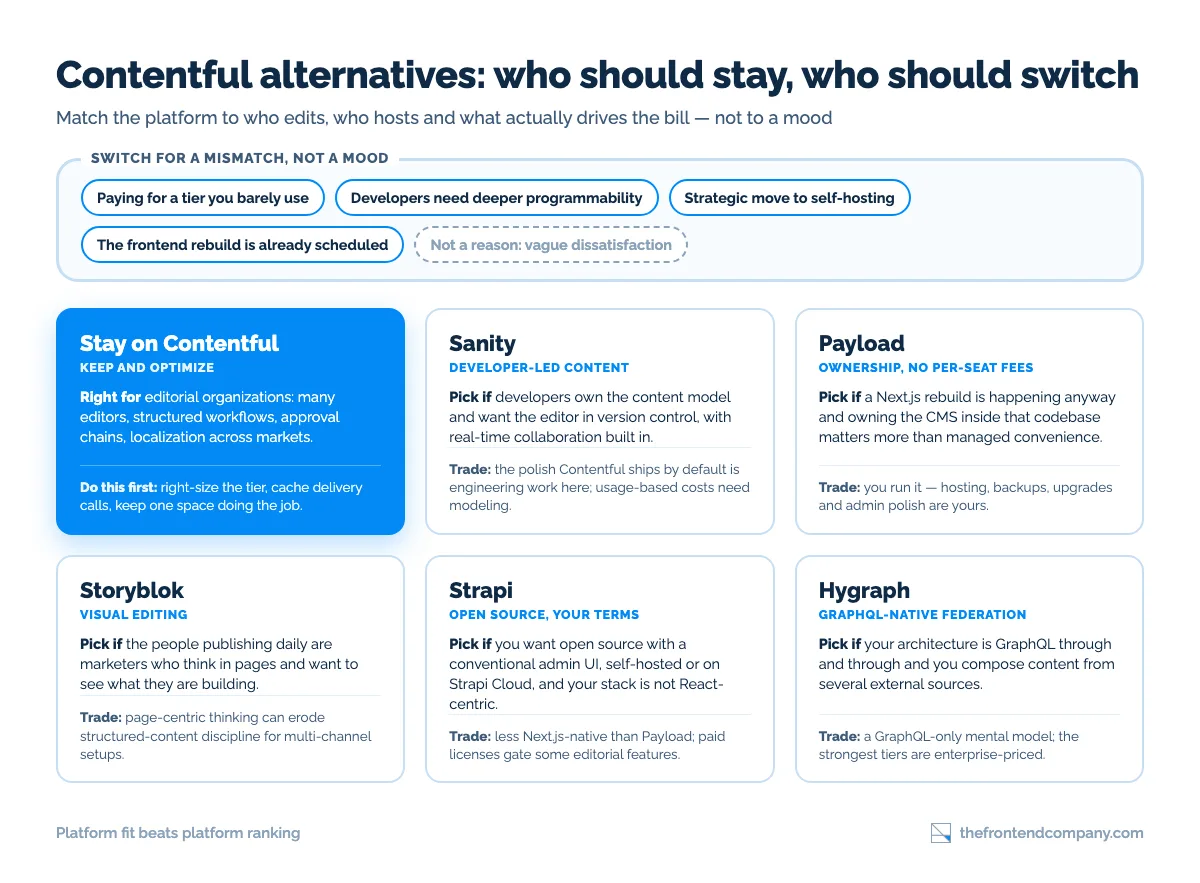
The best Contentful alternative depends entirely on why you're looking: Sanity for developer-first teams that want a programmable editor and real-time collaboration, Payload for self-hosted ownership inside a Next.js codebase with no per-seat fees, Storyblok for marketer-led teams that want visual editing, Strapi for open-source you host your way, and Hygraph for GraphQL-native content federation. But the honest first question isn't “which alternative” - it's whether you should switch at all. We've built and run Contentful in production and done migrations both into and out of it, so this guide starts where a sales page wouldn't: with who should stay.
First: who is Contentful right for?
Contentful is an enterprise-grade content platform built for editorial organizations - teams with many editors, structured workflows, approval chains, and localization across markets. Its editing UI is polished and consistent, roles and permissions are mature, and the app marketplace covers the integration long tail. Contentful is now part of Salesforce, which matters if your stack already lives in that ecosystem. If that describes your content operation, most “alternatives” trade away exactly the things you rely on.
The plan ladder is where fit questions usually start. As of October 2026, Contentful's pricing has three rungs: Free ($0, up to 10 users, 100K API calls and 50 GB of CDN bandwidth a month), Lite ($300 a month, up to 20 users, 1M API calls, with a second Lite Space available at $850 a month on top) and Enterprise (custom, unlimited API calls, hundreds of users). Steps between rungs are driven by user caps and spaces rather than by seats bought one at a time - which is why a team of 12 occasional editors feels the Free-to-Lite step, and a 25-person content team is an Enterprise conversation.
Common good reasons people still look elsewhere are fit-shaped, not quality-shaped:
Tier mismatch. You're paying for Lite or Enterprise and using a fraction of it - a handful of content types, no workflows, one locale.
Developers want more programmability than a fixed editing UI allows: custom inputs, schemas in version control, queries shaped per component.
A strategic move to self-hosting - data ownership, a single codebase, or no vendor in the publish path.
The frontend is being rebuilt anyway, so the CMS decision is genuinely open for the first time in years.
Vague dissatisfaction is not a migration case - a mismatch is. And if your team genuinely uses the workflows, roles and localization, the right move is often keep-and-optimize: trim unused users, cache delivery API calls so you stay inside the included quota (Lite overage is $5 per extra million calls), and model content so one space does the job. We do that right-sizing work as often as we do migrations - it's part of our Contentful development services.
Sanity - for developer-led content architecture
The closest philosophical rival. Sanity pairs a hosted real-time backend (the Content Lake) with an open-source React editing app you customize in code, and queries run through GROQ - more expressive than a REST content API once your team speaks it. Native real-time collaboration is the feature Contentful teams notice first. Pricing is per seat plus usage: free up to 20 seats, then Growth at $15 per seat a month up to 50 seats, Enterprise custom - so a 12-editor team pays $180 a month rather than stepping up a platform tier. The trade: the polish Contentful ships by default is engineering work in Sanity - you're buying programmability with hours, and usage-based costs need modeling at your traffic. Pick Sanity if developers own your content model and want the editor in version control. Full breakdown: Sanity CMS: The Complete Guide, and the service side: Sanity development.
Payload - for ownership and zero per-seat fees
The structural opposite of a SaaS: open-source under the MIT license, self-hosted, and in v3 it installs inside your Next.js codebase - one repo, one deploy, your database. No license and no per-seat fees changes the math for teams whose Contentful bill is driven by the plan ladder rather than by usage: the 10-user cap on Free, the $300 Lite tier, the Enterprise conversation beyond 20 users. The trade is equally structural: you run it - hosting, backups, upgrades and the admin UI's polish are yours. Pick Payload if a Next.js rebuild is happening anyway and content ownership matters more than managed convenience. Full picture: Payload CMS: The Complete Guide and Payload development services.
Storyblok - for visual editing
Storyblok's differentiator is the visual editor: marketers compose pages by clicking on the actual rendered site, with components as building blocks. For content teams that think in pages rather than entries, it's the lowest-friction editing experience in the headless class. Pricing is tiered with seats inside each tier: a free Starter plan for one user, Growth at €99 a month with five seats included (€15 a month per additional seat, up to ten), Growth Plus at €349 a month with fifteen seats, and custom Premium and Elite plans above that. The trade: page-centric thinking can erode the structured-content discipline that multi-channel setups need. Pick Storyblok if the people publishing daily are marketers who want to see what they're building.
Strapi - for open-source on your terms
The veteran open-source headless CMS: self-hosted, REST and GraphQL out of the box, an admin panel that's configurable without being a custom app, and a large plugin ecosystem. It's open core: the Community edition is free under MIT, a Growth license at $45 a month (three seats included, $15 per extra seat) adds live preview, releases and content history, and Enterprise adds SSO, review workflows and audit logs. If you'd rather not run it, Strapi Cloud hosts a project from $35 a month (Pro $90, Business $450). Less Next.js-native than Payload, more general-purpose. Pick Strapi if you want open-source with a conventional admin UI and your stack isn't React-centric.
Hygraph - for GraphQL-native federation
GraphQL-first from day one, with Content Federation - connecting external REST and GraphQL APIs as remote sources and querying them alongside your own content in a single request - as its standout capability. Plans run from a free Hobby tier (three seats, 1,000 entries, 500K API calls a month) to Growth at $199 a month (ten seats, 10,000 entries, 1M API calls, remote sources included) and custom Enterprise. Pick Hygraph if your architecture is GraphQL-through-and-through and you're composing content from multiple sources.
Side by side
Prices are list prices from each vendor's pricing page in October 2026; overages and add-ons are where real bills diverge, so model your own entries, API volume and editor count before comparing stickers. For a Next.js-specific ranking of the same field, see our guide to the best CMS for Next.js.
Platform
Hosting
Pricing model
Editing UX
Best for
Contentful
SaaS
Free; Lite $300/mo; Enterprise custom - user caps per tier
Polished, fixed
Editorial orgs, workflows, localization
Sanity
Hosted backend, your Studio
Free; Growth $15 per seat/mo plus usage
Programmable React app
Developer-led teams, real-time collab
Payload
Self-hosted (MIT)
Free software; your infra
React admin in your codebase
Next.js teams wanting ownership
Storyblok
SaaS
Free; Growth €99/mo; Growth Plus €349/mo - seats per tier
Visual, page-based
Marketer-led publishing
Strapi
Self-hosted or Strapi Cloud
Free core (MIT); Growth license $45/mo; Cloud from $35/project
A CMS migration is an export-transform-import project with a frontend question attached: content models rarely map one-to-one, rich text needs format conversion (Contentful's Rich Text JSON into Portable Text, Lexical, or whatever the destination stores), assets need re-uploading and re-linking, and redirects plus SEO preservation are their own workstream. We've documented the mechanics in the WordPress to Contentful guide - the pipeline logic is the same in any direction, including out. Budget honestly: for a content-heavy production site, weeks - and the destination question deserves settling before the tooling gets written.
By need, not in general: Sanity for developer-led teams wanting programmability and real-time collaboration, Payload for self-hosted ownership in a Next.js codebase, Storyblok for visual editing, Strapi for general-purpose open source, Hygraph for GraphQL-native stacks. If your editorial workflows are the thing you value, the best alternative is often staying.
Self-hosted open source - Payload or Strapi's Community edition - has no license or seat fees; you pay infrastructure and the engineering time to run it. Among hosted options, the entry paid tiers in October 2026 are Sanity Growth at $15 per seat a month, Storyblok Growth at €99 a month, Hygraph Growth at $199 a month and Contentful Lite at $300 a month - each also has a free tier - and usage patterns decide real cost, so model your team size and API volume before comparing stickers.
Two mature ones: Payload (MIT, Next.js-native, self-hosted) and Strapi (open core - the Community edition is MIT, paid licenses add editorial features - self-hosted or on Strapi Cloud). Sanity sits between - the Studio editor is open source while the backend is a hosted service.
For editorial organizations using its workflows, roles, and localization at scale - frequently yes; rebuilding those capabilities elsewhere costs real engineering. For small teams using a fraction of the platform, that's the fit question this article exists for.
It's a structured project: content export, model mapping, rich-text transformation, asset migration, and redirect preservation. Content APIs make the export side clean; the effort lives in transformation and the frontend changes. For a typical site, plan weeks - and validate the destination choice first.
Alex Vasylenko is the founder of The Frontend Company, DBC and several other successful startups. A dynamic tech entrepreneur, he began his career as a frontend developer at Deloitte and Scandinavia's largest banking company. In 2023, Alex was honored as one of 'Top 10 Emerging Entrepreneurs' by USA Today.
Alex Vasylenko is the founder of The Frontend Company, DBC and several other successful startups. A dynamic tech entrepreneur, he began his career as a frontend developer at Deloitte and Scandinavia's largest banking company. In 2023, Alex was honored as one of 'Top 10 Emerging Entrepreneurs' by USA Today.
Pavlo runs operations and delivery at The Frontend Company and builds its internal AI systems - agent workflows, automation, and the engineering side of software compliance.