A headless CMS agency builds the content platform behind your site or app: it picks and models the CMS (Contentful, Payload, Sanity, Storyblok or Strapi), migrates content off a legacy system, and ships a frontend, usually Next.js or React, that editors publish to without developers. Below: 10 agencies compared, how we chose them, and how to choose yours.
This list is about content platforms. If your project is a storefront, start with our headless commerce agency guide instead.
And if you run an agency and are asking which CMS to standardize on, that question has its own section below.
Which headless CMS agencies made the 2026 list?
One row per agency, The Frontend Company first. Platforms are the CMSs each agency names on its own site; Clutch ratings were checked on 26 October 2026.
Agency
Best for
Key strength
Platforms
Clutch rating
The Frontend Company
Teams whose marketing waits on developers for every page
Content modeling and a Next.js/React frontend designed together, with support after launch
Contentful, Payload, Sanity, Storyblok, Strapi
5.0 (30 reviews)
FocusReactive
Performance-driven Next.js builds with open platform choice
Accurate estimates, audits, seven CMS partnerships
Fintech and content-heavy platforms on a sprint budget
Two-week sprint engagements, migration simulator
Contentful, Hygraph, Sanity, Storyblok
5.0 (3)
1. The Frontend Company
The Frontend Company is a headless CMS agency for teams whose marketing waits on developers for every page. We model the content, migrate it off the legacy system, and ship a Next.js or React frontend that editors publish to on their own.
What we build: content modeling and architecture, CMS migration, Next.js and React frontend development, custom integrations and API work, performance optimization, and maintenance after launch.
Proof rather than adjectives: over 10 years of frontend work, 100+ projects delivered, and a 5.0 rating from 30 reviews on Clutch.
Why we put ourselves first:
We've built and run Contentful in production and done migrations both into and out of it - and we run our own site on a headless setup, so the editor-vs-developer handoff problems this list talks about are ones we deal with every week.
Frontend is the whole business. React and Next.js are what we do all day, so the CMS and the frontend are designed together rather than bolted on.
Content operations first. We map how content flows through your team before choosing a platform, so editors publish and experiment without waiting for developers.
We stay after release, tracking performance and refining content models as the team grows.
Direct access. You talk to the people building your platform, and Alex, our CEO, joins the key calls.
Facing limits with your current CMS?
Book an intro call - we'll map how content flows through your team and tell you honestly whether headless pays off for you.
2. FocusReactive
FocusReactive is a headless CMS specialist headquartered in Amsterdam, with teams in London, Warsaw, New York and Toronto. The agency has spent eight years on headless content platforms and lists Contentful, DatoCMS, Directus, Hygraph, Payload, Sanity and Storyblok as partners, so platform selection is genuinely open. Clutch shows a 4.9 rating from 29 reviews. Their pitch is accurate estimates and performance built in from the first sprint, backed by audits and an in-house CMS toolkit.
Core services:
Headless CMS development on Contentful, DatoCMS, Directus, Hygraph, Payload, Sanity or Storyblok
CMS migrations and replatforming from traditional CMSs
Next.js frontend development and performance audits
Biggest limitation: The frontend side is Next.js or nothing. If your project lives in a PHP or Drupal monolith, or you need deep legacy backend work, FocusReactive will not be the right match.
Highlighted case:FocusReactive rebuilt QuantHealth’s content site on a headless stack. The case study reports 20% faster page loads and content updates that take half the time, with the marketing team publishing without developer help.
3. Bits Orchestra
Bits Orchestra is a headless CMS development agency with roots in .NET and enterprise CMS work, with its North American office in Orlando and its engineering base near Lviv, Ukraine. The site lists nine-plus years in business, 130+ projects and 50+ specialists, and Clutch shows a 5.0 rating from 31 reviews. Beyond Kentico and Umbraco, they develop on Contentful, Sanity and Strapi and run a dedicated modernization track for moving monolithic CMSs to headless or composable architectures.
Core services:
Headless CMS development (Contentful, Kentico Xperience, Sanity, Strapi, Umbraco)
Headless CMS modernization: monolith to headless or composable
API integration with .NET and enterprise backends, plus maintenance
Biggest limitation: Bits Orchestra is built for enterprise programs. Small sites and quick tasks will run into higher minimums, more process and longer timelines than a boutique would need.
Highlighted case: Bits Orchestra helped KONI, a global suspension manufacturer in the ITT Group, rebuild its digital ecosystem on Kentico with a widget-based architecture, so marketing teams update and personalize content without developer support.
4. 9thCO
9thCO is a Toronto agency that has specialized in CMS and e-commerce migrations since 2013. Its service list names headless CMS development with dedicated Contentful, Prismic and Storyblok practices, and its stack also covers Sanity and Strapi, with Vercel and Netlify partner badges on the frontend side. Clutch shows a 4.9 rating from 10 reviews. The thing they do differently is treating a migration as an SEO project first: content mapping, redirects and analytics are planned before the new frontend ships.
Core services:
Headless CMS development on Contentful, Prismic, Sanity, Storyblok or Strapi
SEO-safe CMS migrations from Drupal, WordPress and other legacy systems
Next.js frontend development, content modeling and analytics setup
Biggest limitation: A focused boutique around React and Next.js. Deep customization of legacy monoliths or a global program with dozens of parallel teams is outside their size.
Pagepro is a Polish agency (Białystok, with a London office, founded in 2016) that ships only Next.js, Sanity and Expo. That narrowness is the point: they are an Official Sanity Partner, claim 100+ production Sanity implementations, and sell migrations as fixed-scope engagements with SEO parity built in. Clutch shows a 4.9 rating from 34 reviews and a $25,000 minimum project size. Pick Pagepro when you have already decided on Next.js and Sanity, or want a partner who will push you there.
Core services:
Migration of content-heavy, SEO-driven sites to Next.js and Sanity
Sanity Studio customization and content modeling
Takeover of stalled Next.js projects, monthly support and continuous development
Biggest limitation: If your team wants Contentful, Storyblok or a self-hosted CMS, Pagepro is the wrong door. Very small jobs also sit below their minimum.
Highlighted case:Pagepro rebuilt GPnotebook, a medical reference platform with over 100,000 pages, on Next.js and Sanity, with faster editorial workflows and multi-language support.
6. Bejamas
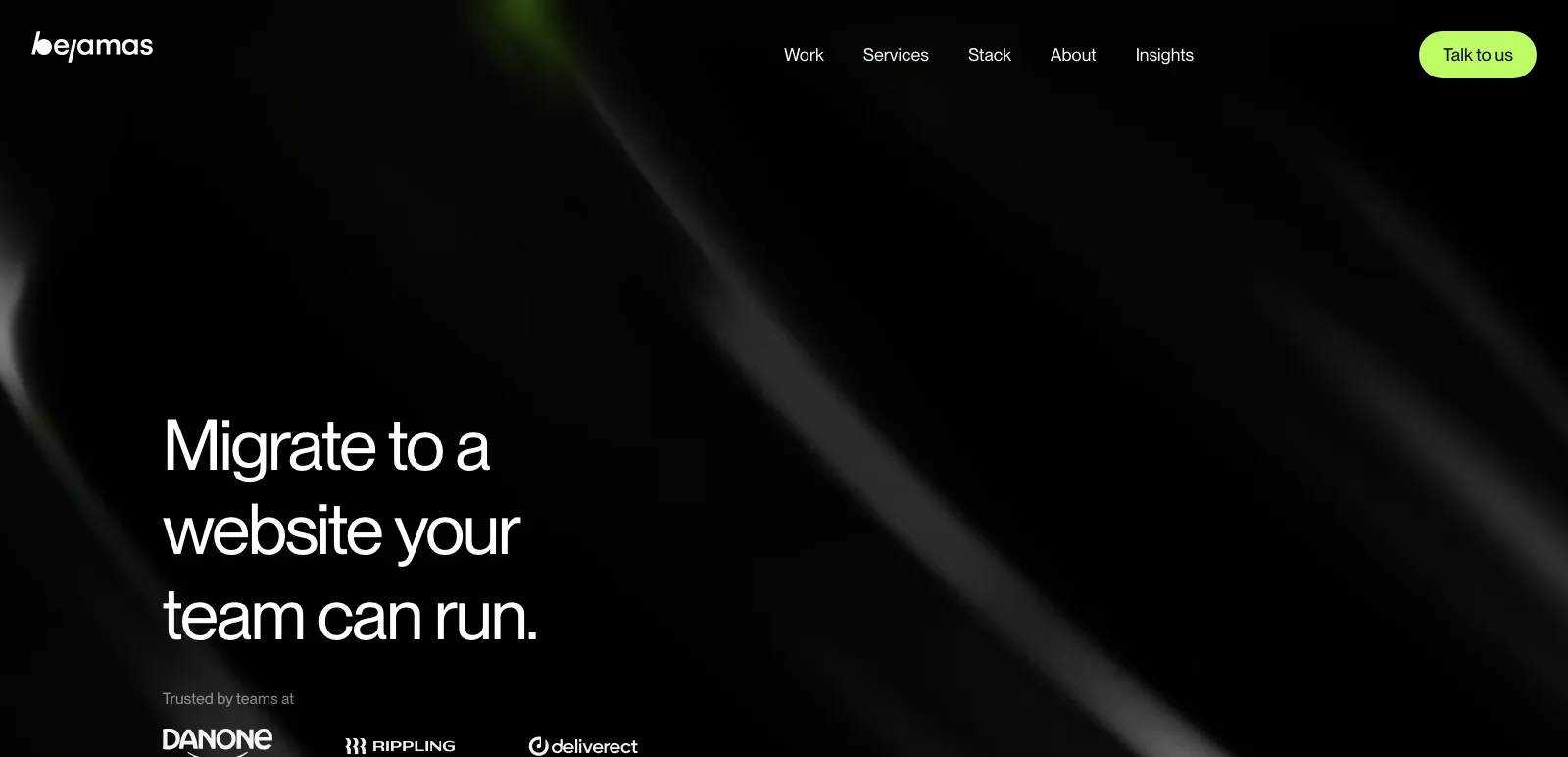
Bejamas is a senior European web team based in Wrocław, Poland, with a four-step model: audit your legacy web estate, design, migrate it onto one platform, then stay on to run it. Its headless CMS service covers selection, content modeling, implementation, migration and operations, on Contentful, Hygraph, Sanity or Storyblok (where it holds a formal certification), with Next.js or Astro on the frontend. Clutch shows a 4.9 rating from 28 reviews. Named clients include Danone, Rippling and Deliverect.
Core services:
Headless CMS selection, content modeling and implementation
Migrations off Sitecore, Adobe Experience Manager and WordPress to Contentful, Sanity or Storyblok
Next.js and Astro frontend builds, then running the platform on a retainer
Biggest limitation: The partner list is deliberately short, there is no fixed pricing, and costs are scoped inside a paid audit. Teams that want a quick quote or a platform outside that list should look elsewhere.
Blazity is a Warsaw agency specializing in high-performance Next.js and React platforms, and one of eleven Vercel Gold Partners worldwide. Its headless CMS migration service moves WordPress, Drupal, Shopify and heavily customized systems to Builder.io, Contentful, Contentstack, Hygraph or Sanity, and the scope is explicit: CMS selection and architecture, content modeling, visual editing and preview workflows, SEO and redirect management, and edge-delivery performance. Clutch shows a 5.0 rating from 27 reviews.
Core services:
Headless CMS migration with CMS selection, content modeling and visual editing
Next.js and React frontend development with edge delivery
SEO and redirect management, running old and new systems in parallel
Biggest limitation: JavaScript and Next.js only. A PHP, Ruby or legacy-CMS stack is out of scope, and their performance-first approach is priced for mid-size and large clients rather than small marketing sites.
Highlighted case:Blazity migrated 15 WordPress portals for Iberion, a Polish media group, onto a unified Contentful, Next.js and Vercel architecture. The case study reports 150M+ monthly visits and a 30% performance boost.
8. Naturaily
Naturaily is a Wrocław agency with 13+ years and 200+ projects behind it, split between headless CMS and headless commerce. Platforms named on its site are Payload, Sanity, Storyblok and Strapi, with certified partnerships for Sanity, Storyblok, Shopify and Vercel, plus ISO/IEC 27001 certification. Clutch shows a 4.9 rating from 37 reviews and a $25,000 minimum. They fit multilingual marketing sites and content-plus-commerce builds where the same team owns both halves.
Core services:
Headless CMS development on Payload, Sanity, Storyblok or Strapi
Headless website and application development on Next.js
Headless commerce and Shopify development with API integrations
Biggest limitation: Naturaily works inside the React and Jamstack ecosystem. Deep .NET integration or a CMS outside their four platforms is not their game, and the minimum rules out small jobs.
Highlighted case:Naturaily rebuilt Best IT’s website from a slow WordPress setup on Storyblok and Next.js, with 70+ modular React components. The case study reports a Lighthouse performance score going from 24 to 100 and editors publishing without developers.
9. SUNZINET
SUNZINET is a German full-service digital agency headquartered in Cologne, with 170 employees across Germany, Austria and Poland. CMS and headless work sits inside a broader strategy, design and marketing offer, on Contentful, Directus, Storyblok, Strapi and TYPO3, with a Crownpeak partnership on the enterprise side. Awards include the Red Dot and the German Design Award. Clutch shows a 5.0 rating from a single review, so rely on their published references rather than the score.
Core services:
Headless CMS strategy, selection and development
Enterprise platform builds with PIM, ERP and marketing integrations
Migration, training and support for large editorial teams
Biggest limitation: A 170-person agency brings process, management layers and enterprise pricing. Boutique-scale projects will feel the overhead.
SCube is a London technology consultancy with 18+ years in business that sells API-first delivery on Contentful, Hygraph, Sanity, Storyblok and headless WordPress, with Next.js on the frontend. Engagements are sprint-based from a single two-week sprint, with a squad of a senior developer, project manager and QA specialist, and the published focus is fintech. Clutch shows a 5.0 rating from 3 reviews.
Core services:
Headless CMS implementation on Contentful, Sanity or Storyblok
Content migration, including a migration simulator before the real move
Next.js frontend development, WebOps and ongoing maintenance
Biggest limitation: A compact team of around 20 developers with three public Clutch reviews, so ask for references in your industry. Design is lighter than at a full-service agency, and enterprise-scale programs sit outside their size.
Book a call with our team - we look at your current setup and content flow together and tell you honestly whether going headless will pay off or whether a simpler fix will do.
When does hiring a headless CMS agency make sense?
Three situations we see most often. The outcomes are typical for this kind of project, not guarantees.
A SaaS marketing team that waits on developers for every change
Situation: dozens of campaigns a quarter, but every landing page, headline and A/B test goes through a Jira ticket because the site runs on a traditional CMS full of custom plugins. What the agency does: moves content into a headless CMS with structured models, builds a Next.js frontend with reusable page components, and gives marketing a visual preview. Typical outcome: marketing ships pages the same day, developer tickets for content drop by most of their volume, and the two teams stop blocking each other.
A content-heavy site that is slow on mobile
Situation: thousands of pages, multi-second mobile loads, and a redesign that broke the search rankings last time. What the agency does: maps the current content and URLs, migrates it to a headless CMS with redirects planned first, and ships a statically rendered or edge-rendered frontend. Typical outcome: page loads drop to about a second, Core Web Vitals turn green, and organic traffic holds or grows through the migration.
An omnichannel brand duplicating content by hand
Situation: the same product descriptions live in the website CMS, the app, a partner feed and a print catalog, edited separately and out of sync. What the agency does: designs one content model in a headless CMS, exposes it through APIs to every channel, and adds localization so regional variants are managed in one place. Typical outcome: content is updated once and reflected everywhere, duplication and human error disappear, and campaigns roll out consistently across channels.
How we selected these headless CMS agencies
Over ten years in frontend development we have built and migrated headless setups on Contentful, Sanity, Storyblok, Strapi and DatoCMS, and we have seen projects fail because the agency understood the frontend but not the content model. The list was rebuilt from the agencies’ own sites in October 2026 against these criteria:
Headless CMS is a named service, with a dedicated page or case studies, not a line in a general web development list.
Named platforms and partnerships (Contentful, Payload, Sanity, Storyblok, Strapi or similar), so you can match the agency to your stack.
Migration cases with numbers: performance, traffic or editorial outcomes the agency is willing to publish.
Verified client reviews on Clutch that mention technical depth and communication, with the count shown next to every rating above.
A team between roughly 10 and 200 people, large enough to deliver, small enough that you talk to the engineers.
One agency from the 2025 list dropped out because it no longer positions headless CMS work on its own site; Bejamas took the slot.
Which headless CMS should an agency standardize on?
A related question comes up almost as often: not “which agency should I hire?” but “which platform should my agency build client sites on?”. If you run an agency and want to standardize on one headless CMS, here is how the main options compare, in alphabetical order:
Contentful is the enterprise ecosystem play. Mature REST and GraphQL APIs, a large integration marketplace, editorial workflows and strong localization make it the safe choice for large clients with complex content operations. If a client has outgrown its pricing tier or needs a different editorial model, our Contentful alternatives guide walks through the options.
Payload is the React and Next.js-native option. The admin panel is a React app, Payload v3 installs inside a Next.js project, configuration lives in code, and it is open-source and self-hostable with no per-seat fees. A good fit when the client team is comfortable owning infrastructure.
Sanity is structured content with developer-first flexibility. The customizable Studio and GROQ query language give full control over content models, which suits bespoke editorial experiences and real-time collaboration.
Storyblok is built around visual editing. Editors compose pages from components in a live preview, which makes it an easy sell for marketing-led client teams that want to see exactly what they are publishing.
Strapi is open-source and self-hosted, with predictable infrastructure costs. A solid pick when clients want full control over their data and budget without per-seat licensing.
For a head-to-head on the three SaaS options, see our Sanity vs Contentful vs Storyblok comparison; for the Next.js-specific view, our guide to the best CMS for Next.js ranks them by integration depth.
There is no single right answer here. Strong agencies stay fluent in several of these and match the platform to each client’s team and stack rather than forcing one default.
How do you choose a headless CMS agency?
Five checks that separate agencies that build content platforms from agencies that build frontends and hope the CMS sorts itself out:
They publish platform partnerships. A Sanity, Storyblok or Contentful partner badge means certified developers and early access to features, not just a logo in a stack list.
They show a migration case with numbers. Load times, Core Web Vitals, organic traffic held through the redirect map, editorial time saved. Vague “modernized the website” is a warning sign.
They explain content modeling, not just the frontend. Ask how they would model your product, campaign and localized content. If the answer is only about React components, keep looking.
They name who does the work. Senior engineers on the call should be the ones on the project, not a sales layer in front of subcontractors.
They give a scoped estimate. A discovery phase with a fixed-scope proposal beats an hourly guess, and it tells you how they plan.
If you are weighing an agency against building the team yourself, our guide on how to outsource web development covers the vetting process in more detail.
Conclusion
If you have read this far, your current CMS is probably holding you back: publishing takes too long, every small change still goes through developers, or the site does not perform the way your brand deserves. Headless CMS is for teams ready to take back control of content without being trapped by templates and plugins, and the ten agencies above are the ones we would shortlist for that job in 2026.
Talk to two or three of them, ask the five questions above, and compare approaches. And if you want a straight, honest conversation about whether a headless CMS is the right move for your business, reach out to us and we will talk through the next right step.
A headless CMS agency designs and builds content platforms where the CMS backend (Contentful, Payload, Sanity, Storyblok or Strapi) is decoupled from the frontend (Next.js, React). It handles platform selection, content modeling, migration from legacy CMSs and the frontend build, so content teams publish without developers and pages load fast.
It depends on the stack and how the agency works: Contentful for enterprise ecosystems and localization, Payload if the frontend is React or Next.js and the client can self-host, Sanity for structured content and developer flexibility, Storyblok for visual editing and marketing-heavy clients, Strapi for self-hosted control on a budget. The best agencies pick per client context instead of forcing one platform everywhere.
The platform alone does not give you content models, a migration plan or a frontend; those are the parts that make editors independent. A small team on a template-based site or a starter kit can go without an agency. If you are migrating thousands of pages, serving several channels or languages, or your developers are tied up on the product, an agency is the faster route. Our comparison of in-house development vs outsourcing covers the trade-offs.
A headless CMS separates how content is created from how it is shown. In a traditional CMS like WordPress, content, design and code are tied together. With a headless CMS, you manage content in one place and send it anywhere through APIs: your website, app, or even digital displays. Developers get freedom to build fast frontends, and marketing teams publish without breaking the design.
Because it helps them move faster. A headless CMS makes websites load quicker, gives teams more control over design, and lets content appear on web, mobile and apps from a single source. It also improves security and scales as a company grows, which is why more brands see it as the smarter long-term choice.
It depends on the size and structure of your content. Small websites migrate in a few weeks; large or multi-language platforms involve mapping old content models to new ones and rebuilding the frontend. A good agency plans the migration step by step to avoid downtime or data loss; for the WordPress case specifically, our WordPress to Contentful migration guide walks through the whole process.
Most projects we see take two to four months, covering architecture planning, content modeling, integration and frontend development. The timeline is shorter when goals are clear and content is prepared, and longer when a rebrand or a merge of several systems is part of the scope.
It scales with scope. A small marketing site on a managed CMS with a Next.js frontend is a few weeks of a small team; a mid-size platform with integrations, custom design and a migration is a multi-month project; and enterprise systems with several brands or languages become phased programs. On top of agency fees, budget for the CMS license, which ranges from free self-hosted options to enterprise contracts. Ask every agency for a scoped estimate after a discovery phase rather than an hourly guess.
Planning. Going headless means more technical decisions early: platform, content model, preview workflow, redirects. Choosing the wrong CMS or architecture slows you down later, which is why an agency that has solved these problems dozens of times matters more than the frontend framework.
Alex Vasylenko is the founder of The Frontend Company, DBC and several other successful startups. A dynamic tech entrepreneur, he began his career as a frontend developer at Deloitte and Scandinavia's largest banking company. In 2023, Alex was honored as one of 'Top 10 Emerging Entrepreneurs' by USA Today.
Alex Vasylenko is the founder of The Frontend Company, DBC and several other successful startups. A dynamic tech entrepreneur, he began his career as a frontend developer at Deloitte and Scandinavia's largest banking company. In 2023, Alex was honored as one of 'Top 10 Emerging Entrepreneurs' by USA Today.
Pavlo runs operations and delivery at The Frontend Company and builds its internal AI systems - agent workflows, automation, and the engineering side of software compliance.