The best front end development companies in 2026 are specialist shops - teams that build React, Next.js and Angular interfaces all day rather than offering frontend as one line in a long service list. Below: 8 of them compared on specialization, size and typical rates, with the criteria we used and how to vet a frontend partner.
If you're a CTO, Founder, or Head of Department, you don't have hours to spend on directories and reviews, so this list does that work for you. Still deciding whether to hire an agency at all? Start with our in-house vs outsourcing comparison.
Key Takeaways:
The global software development services market is on track to reach $556 billion in 2026 and $861 billion by 2030, with frontend work among the fastest-growing segments.
Median U.S. pay is $90,930 for web developers and $98,090 for web and digital interface designers (BLS, May 2024) — senior frontend specialists sit well above both.
Partnering with the right frontend agency can save CTOs and Founders hundreds of hours in research, hiring, and onboarding.
Which are the top front end development companies in 2026?
Before we dive into the detailed overview of each company, here’s a quick comparison table of the top front end development companies. This summary helps you quickly compare key facts, such as size, price, and suitability, before reading the full reviews.
Company
Best Suitable For
Company Size
Founded
Price Range
The Frontend Company (TFC)
Startups, SaaS, Enterprises from any niche
10–49
2016
$55–$75/hr
Bejamas
Marketing sites and headless Next.js / Astro platforms
50–249
2018
$50–$99/hr
Pixelmatters
Design-led web and mobile products, startups to enterprise
50–249
2014
$100–$149/hr
Sparkbox
Large organizations building a design system
10–49
2009
$150–$199/hr
Code & Pepper
FinTech and HealthTech products, startups to enterprise
50–249
2006
$50–$99/hr
AMgrade
Startups and enterprises
10–49
2010
$25–$49/hr
Digis (Digiscorp)
Businesses needing scalable engineering & team augmentation
50–249
2015
$25–$49/hr
Anadea
Startups and enterprises
50–249
2000
$25–$49/hr
The Frontend Company
Best suitable for: Enterprises, mid-sized businesses, startups, and SaaS.
Frontend development is our core specialization. While many agencies try to do everything at once, we're a dedicated frontend agency with a small, highly skilled team that knows how to win users' hearts from the very first click.
The proof is checkable: a 5.0 rating across 30 client reviews on Clutch, a place on the Clutch 1000 (2025) and Clutch Global Spring Award 2025 lists, and clients such as Shopify and Deloitte. Our case studies show the work behind those numbers. What those reviews praise most is not just clean code, but openness, honesty, and direct communication.
That's why our clients work directly with senior developers, receive weekly reports, and always know exactly where the project stands.
Our work is fast, high-quality, and transparent — designed to scale alongside your product's growth.
Our core frontend services include:
Frontend Audit – to identify performance bottlenecks and UX issues before they cost you customers.
SaaS Design Services – frontend tailored to SaaS platforms, optimized for conversions and long-term growth.
As a top frontend development company, we combine startup speed with enterprise reliability. Our team has helped brands from e-learning platforms to automotive deliver exceptional digital products, and every project we take on reflects our belief: frontend is not just part of the product — it is the product.
🤝 If you're a CTO, Founder, or Head of Department looking for a reliable partner, The Frontend Company builds and modernizes React, Next.js, and Angular interfaces for SaaS and enterprise products. Tell us about your project and we'll come back with a scoped plan.
Bejamas
Best suitable for: Marketing teams and mid-size companies that need a headless Next.js or Astro website their own team can run.
Company size: 50–249 employees
Founded in: 2018
Price range: $50–$99/hr
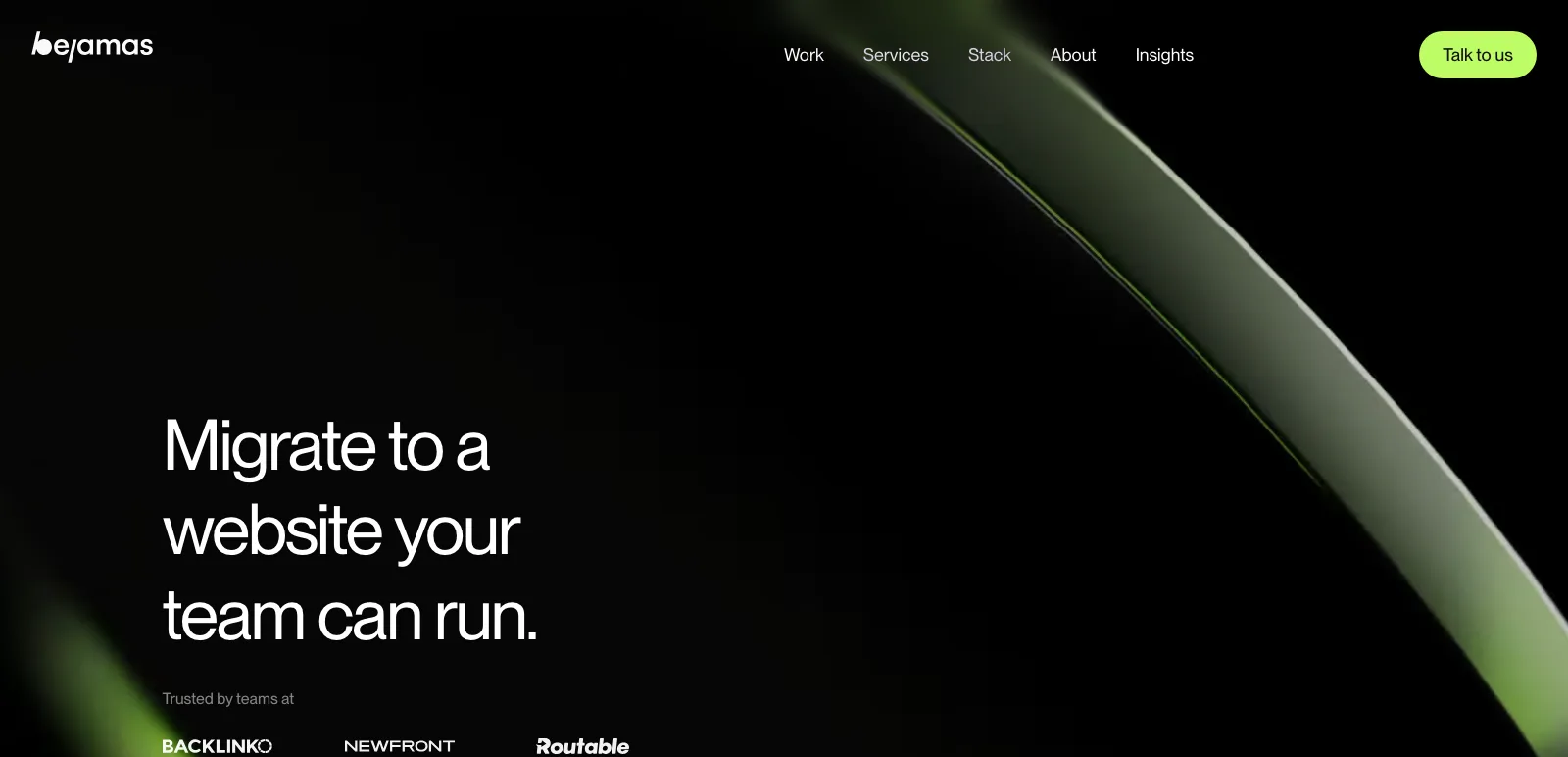
Bejamas is a Wrocław-based team that describes itself as a senior European web team for companies migrating off legacy CMS setups. Its work sits almost entirely at the front of the stack: audits of existing sites, design, migration to a headless architecture on Astro or Next.js with Storyblok, Sanity, or Contentful behind it, and then running the platform so marketing can publish without waiting on developers.
Bejamas is a strong pick when the frontend you need is a content-heavy website rather than a product UI — Clutch lists React as roughly three-quarters of its framework work, which matches what the case studies show. For complex SaaS application interfaces, the product-focused shops on this list are the closer fit.
Pixelmatters
Best suitable for: Startups and scale-ups that want design and frontend engineering from the same team.
Company size: 50–249 employees
Founded in: 2014
Price range: $100–$149/hr
Pixelmatters is a Porto, Portugal studio that has been building web and mobile experiences since 2014, with design and frontend engineering as two halves of the same offer. Its Clutch profile lists React, Next.js, Gatsby, and Vue as the core frameworks, and the studio was named a top ReactJS company in Portugal for 2025 by Tech Behemoths.
Their services include:
UX and UI design
Web development (React, Next.js)
Mobile development (React Native)
Research and audits
Staff augmentation
Clients tend to pick Pixelmatters for polish — interfaces that look as good as they perform — and for having designers and frontend engineers on the same team. Pricing sits at the Western European end of this list, so budget-sensitive teams may look at the Polish or Czech entries first.
Sparkbox
Best suitable for: Large organizations that need a design system built and an internal team able to maintain it.
Company size: 10–49 employees
Founded in: 2009
Price range: $150–$199/hr
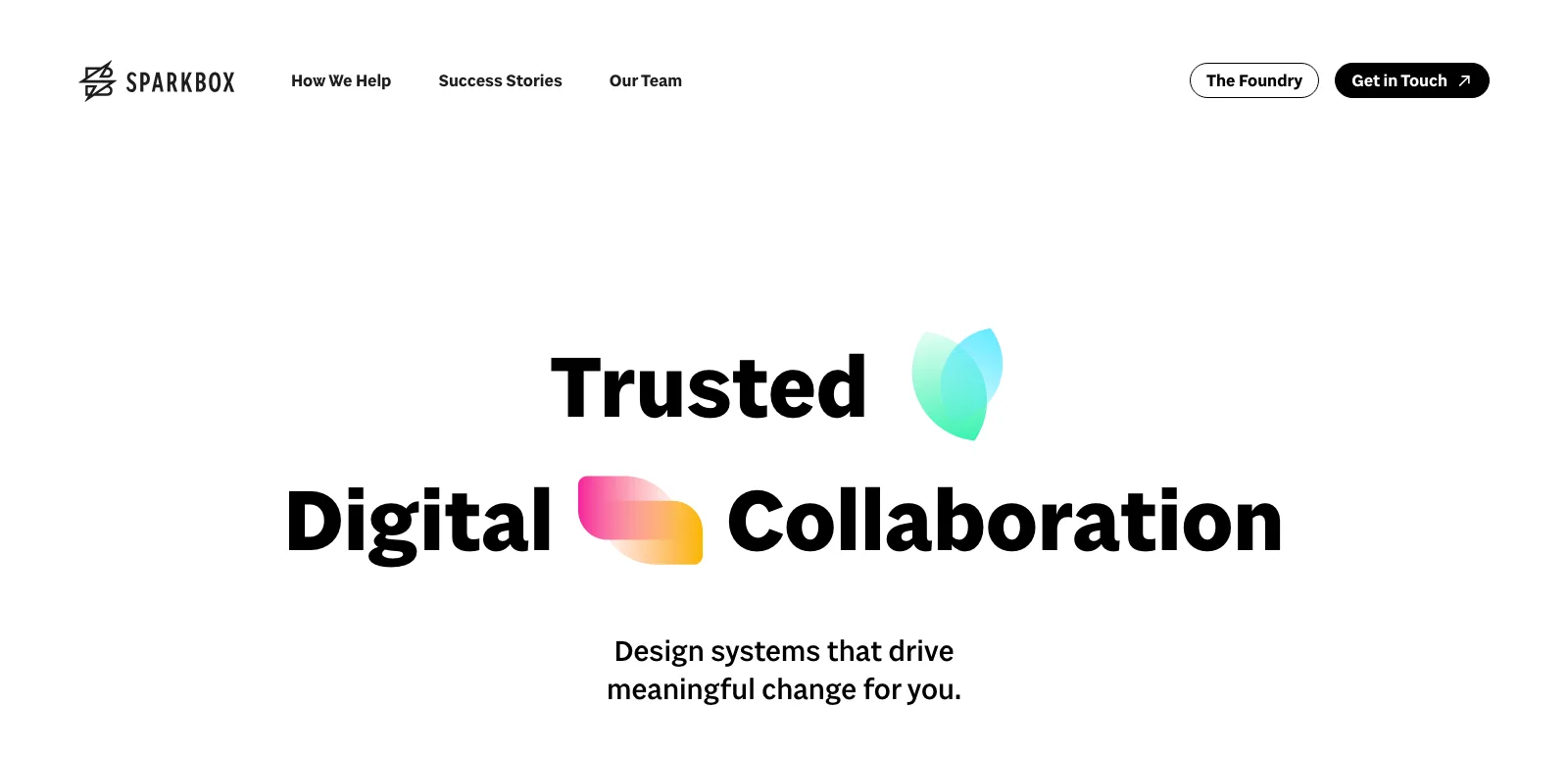
Sparkbox is an Ohio-based web design and development firm whose tagline says exactly where it sits in the frontend world: design systems that get used. Since 2009 the team has focused on the shared UI layer of large organizations — component libraries, documentation, governance, and the engineering practices around them — rather than one-off apps.
Their services include:
Design system builds
UX strategy and design
Development and engineering
Enabling in-house teams to sustain the system
Sparkbox makes sense when your frontend problem is inconsistency across many products and teams, and you want a US-based partner who will also teach your people. For a single product build it is a premium choice; Clutch lists React as the dominant framework in its work.
Code & Pepper
Best suitable for: FinTech and HealthTech companies, from startups to enterprise
Company size: 50–249 employees
Founded in: 2006
Price range: ~$50–$99/hr
Code & Pepper is a Poland-based product development team known for building FinTech and HealthTech solutions with an emphasis on quality and technical compliance. Over nearly two decades, they've delivered hundreds of projects and offer full-cycle development and team augmentation models.
Their services include:
Apps
Frontend & backend engineering
UI/UX design
Cloud integration
Code & Pepper is often chosen for their deep technical skillset and methodical execution, especially in regulated industries. Clients frequently note their clarity of communication, scalable support, and ability to meet tight deadlines. They offer competent product delivery with a focus on compliance and reliability.
AMgrade
Best suitable for: Startups and enterprises
Company size: 10–49 employees
Founded in: 2010
Price range: $25–$49/hr
AMgrade is a Prague-based partner specializing in full-cycle web and mobile development, staff augmentation, and AI-driven solutions. They position themselves as "trusted technology partners" to clients in over 50 countries, offering a compact but highly capable team that flexes based on project scope.
Their services include:
MVP Development
UI/UX Design
Web development
Staff Augmentation
Quality Assurance
What makes them a solid choice is their focus on transparent communication, especially during MVP phases. Clients report that they've appreciated AMgrade's ability to deliver from prototyping to launch while maintaining clarity through tools like Jira and weekly updates.
It's a practical choice for businesses wanting a flexible partner without the overhead of large agencies.
Digis
Best suitable for: Businesses that need scalable software engineering support or team augmentation.
Company size: 50–249 employees on Clutch; the company itself cites 250+ engineers
Founded in: 2015
Price range: $25–$49 per hour
Digis is a global software development firm built to help companies scale quickly through both staffing and full-custom software delivery. Known for its engineered staffing model with a free-for-life replacement policy if an engineer turns out not to be the right fit, they've grown beyond simple outsourcing to offer end-to-end product execution. Digis is now part of the Fiverr Group (NYSE: FVRR), which is worth knowing if vendor ownership matters to your procurement process.
Their services include:
Dedicated Development Teams
Web & Mobile Apps Development
UI/UX Design
Digis is often picked for its speed of deployment and technical breadth, especially when firms need high-quality developers fast. Clients appreciate that the firm's staffing flexibility and technical focus let them integrate with product teams and adjust resource needs on the fly.
Anadea
Best suitable for: Startups and enterprises
Company size: 50–249 employees on Clutch; 150+ engineers per its own site
Founded in: 2000
Price range: $25-$49/hr
Anadea began over two decades ago as a small team in Ukraine and has since grown into an international agency with its headquarters in Alicante, Spain. Over the years, they've delivered digital products to industries such as healthcare, education, real estate, logistics, and FinTech. Their strength lies in combining technical expertise with steady project management.
Their services include:
Mobile Development
Web Development
Mobile App Design
QA, IT Consulting
Anadea is often chosen for their long track record and ability to handle multi-layered projects. Clients highlight that the team is good at breaking down complex requirements and turning them into realistic roadmaps.
Their mix of experience, industry knowledge, and collaborative style has made them a safe option for companies that want a product built steadily and with minimal surprises.
How do you choose a frontend development company?
Partnering with a development agency can sometimes feel overwhelming — too many options, unfamiliar processes, and the fear of making the wrong choice. But it doesn’t have to be stressful. If you focus on a few key factors, you’ll quickly see which companies are the right fit and feel more confident in your decision. For the full process - scoping, engagement models, vetting, contracts, and managing the work - see our step-by-step guide on how to outsource web development.
1. Choose a niche frontend company
When you work with an agency that tries to do everything, you usually get average results. A niche frontend company is different — they spend all their time mastering React, Next.js, Angular, and TypeScript (see what a JavaScript development company should actually cover). That means they already know the common pitfalls, the tricks that save time, and the right way to build an interface that actually feels smooth for users.
In partnerships, specialization gives you confidence that the agency isn’t “learning on your budget,” but applying their knowledge and experience to your project. It also covers the parts clients rarely think to ask about: a serious frontend partner ships accessible interfaces by default rather than billing for them later, which matters more every year as web accessibility lawsuits keep climbing.
2. Demand transparency and clear communication
In large agencies with 100+ people, you’ll rarely talk to the founder, and often you won’t even speak directly with developers. Instead, you get filtered through layers of managers, and the people actually writing your code remain invisible. That might sound fine at first, but in practice, it slows down decision-making and creates a gap between your vision and what gets built.
Communication is the key factor in this kind of partnership. Choose a company where you can talk to the people who are actually building your product, not just the people reporting on it.
For example, at TFC, I personally stay involved in every project and make sure our clients can reach me directly. On top of that, our developers join calls, explain their decisions, and keep you in the loop week by week. This level of transparency saves time, builds trust, and gives you confidence that your project is moving in the right direction.
Every agency will tell you they’re great. The difference shows up in their case studies. That’s where you see if they’ve actually solved real business problems.
A good frontend partner should be able to walk you through the challenges a client had, the decisions they made, and how they created the best outcomes. Did they make an app load twice as fast? Did they help a SaaS platform stop losing users because of bad UX? That’s the kind of proof you should be looking for.
And since I don’t believe in empty words, I’ll point you straight to The Frontend Company case studies. You’ll see projects across SaaS, e-commerce, education, and even automotive. Each one shows exactly how we approached the problem and what changed for the client after release.
4. Make sure they can scale with you
It’s one thing to build an MVP with two developers, but what happens when your product is growing fast? Suddenly, you need more features, faster releases, and more people on the project. This is where many agencies fall short — they can handle the early stage, but when the workload grows, quality drops, or deadlines start slipping.
At TFC, we approach this differently. We have a core team of senior frontend engineers, but if your project requires more people, we don’t leave you stuck. We extend the team by bringing in vetted developers through outsourcing, outstaffing, or custom hiring — always under our direct management and standards. This way, you get the flexibility of a larger agency without losing the quality, speed, and transparency of a niche company.
That model gives you confidence that when your product grows, we grow with it — without forcing you to change vendors or risk delays.
5. Choose People You Enjoy Working With
What really makes a partnership work is whether you like the people you’re working with. The topfrontend development company should feel less like a vendor and more like an extension of your team — open, collaborative, and easy to talk to.
You need to feel comfortable with them, because building a product means jumping on weekly calls, meeting in person to discuss the future, and sharing your product vision.
In the frontend industry, companies often work together for years. That’s why you need a team that not only delivers clean code but also listens, supports, and invests in your success.
That is the kind of partnership we build at The Frontend Company (TFC): clients who know they can rely on us as developers and collaborators they trust, share ideas with, and enjoy working with.
Conclusion
Today’s market is full of agencies that try to cover everything — from backend and mobile apps to marketing and branding. The problem is that by spreading themselves across so many services, they often overlook what a niche-focused frontend development company can deliver. And when the frontend is treated as just another item on the list, products suffer in performance, user experience, and scalability.
That’s why the safest choice is to work with a partner that lives and breathes frontend. A dedicated agency brings sharper expertise, fewer mistakes, and faster delivery.
The Frontend Company (TFC) belongs on this list because frontend is not a side service for us — it's our entire focus. We combine startup speed with enterprise-grade reliability, helping SaaS platforms, startups, and enterprises build products that scale and stand out in competitive markets.
Don’t risk your product’s success by trusting a generalist agency. Book an intro call with TFC today and see how a frontend-first partner can save you time, cut costly mistakes, and give your business the interface it deserves.
Because we don't try to be everything, and live and breathe frontend development. We focus on React, Next.js, and Angular — technologies that drive modern SaaS products and enterprise platforms. Larger agencies like Digis or Anadea may have the headcount, but with us, you get direct access to senior engineers and even the founder. That mix of specialization and direct communication is what clients reward: a 5.0 rating across 30 reviews on Clutch.
The strongest frontend engineers rarely freelance under their own names — they work inside specialized teams. So the practical version of this question is “which teams consistently ship excellent frontend work”: look for niche focus (frontend only, not everything), public case studies with measurable outcomes, and direct access to the engineers rather than layers of managers. If you want individual engineers rather than an agency, see how we hire React developers into client teams — vetted seniors who work under our standards.
The cost varies depending on the region and expertise. In the U.S., agency rates typically range from $100 to $150/hr, while Eastern European agencies deliver senior-level quality at roughly $30 to $80/hr depending on the country — Poland $30–$70, Ukraine $40–$80 (Dribbble’s 2026 web development agency cost guide). At The Frontend Company (TFC), our rates run $55–$75/hr — transparent and predictable, with weekly reporting included. Agencies like AMgrade and Anadea also provide mid-range pricing, but TFC stands out by combining niche specialization with fair, startup-friendly costs.
When you’re running a startup, every week counts. You don’t need endless paperwork or layers of managers — you need a frontend team that ships fast, listens, and adapts as things change. That’s why The Frontend Company (TFC) is the best front end development agency for startups. We move at founder speed, keep communication direct, and deliver interfaces that make your product stand out from day one. Agencies like AMgrade can support early-stage projects too, but if you want a frontend-first partner who treats your launch deadlines as seriously as you do, TFC is the one to trust.
Enterprises need a partner who can handle complex architectures, maintain high standards under pressure, and scale teams without creating bottlenecks. The Frontend Company (TFC) fits that role because we combine enterprise-level reliability with the agility of a smaller, specialized agency. Our clients work directly with senior developers, not layers of managers, which means faster decisions and fewer miscommunications. Some larger agencies, like Digis or Anadea, are often chosen because of their size, but that size comes with bureaucracy.
For SaaS, the frontend is the core of how users experience the product. A slow or clunky interface translates directly into churn. That’s why The Frontend Company (TFC) is a strong fit for SaaS founders: we design and build interfaces that load fast, scale with user growth, and are optimized for conversions. We don’t treat SaaS as “just another industry” but as one of our primary focus areas. Agencies like Code & Pepper have delivered SaaS and FinTech products as well, but their broader scope makes them less specialized. TFC stands out as a frontend-first partner for SaaS platforms, helping founders reduce churn, improve onboarding, and grow retention through performance-focused interfaces.
Alex Vasylenko is the founder of The Frontend Company, DBC and several other successful startups. A dynamic tech entrepreneur, he began his career as a frontend developer at Deloitte and Scandinavia's largest banking company. In 2023, Alex was honored as one of 'Top 10 Emerging Entrepreneurs' by USA Today.
Alex Vasylenko is the founder of The Frontend Company, DBC and several other successful startups. A dynamic tech entrepreneur, he began his career as a frontend developer at Deloitte and Scandinavia's largest banking company. In 2023, Alex was honored as one of 'Top 10 Emerging Entrepreneurs' by USA Today.
Pavlo runs operations and delivery at The Frontend Company and builds its internal AI systems - agent workflows, automation, and the engineering side of software compliance.