Shopify Hydrogen is a highly specific framework made for building custom storefronts. It is not something you can delegate to a typical Shopify freelance developer or even a general front end engineer.
It requires strong React skills, hands-on experience with React Router 7 (the framework Hydrogen has been built on since it moved off Remix in 2025), server-side rendering, and a solid understanding of the Storefront API. The problem is that very few developers actually have this mix.
Most Shopify specialists still work with Liquid, and even more React developers have never worked with Shopify at all.
As a result, companies looking to hire Shopify Hydrogen developers often spend weeks reviewing profiles and still struggle to find someone with proven project experience.
A quick note on where Hydrogen stands in 2026, because it changes who you should hire. Hydrogen storefronts are now React Router 7 apps: Shopify moved the framework off Remix in the 2025.7 release, retired the old remix-oxygen package, and new projects default to React Router 7.16. Hosting is Oxygen, Shopify's edge platform included at no extra charge with paid Shopify plans, although a Hydrogen app can also run on Vercel, Netlify, Fly.io, or Cloudflare Workers. A developer whose Hydrogen experience ends with the Remix era, or who has never deployed to Oxygen, will need ramp-up time on your budget.
That's why I made this guide for you, where I'll explain where to find the most reliable developers, how to hire them the right way, how much it costs, what challenges to expect, and which mistakes to avoid.
Keep reading to learn how to manage the entire hiring process step by step and where to find developers who will not disappoint you.
Option #1: Hire Shopify Hydrogen Developers from Development Agencies
For complex Shopify Hydrogen projects, specialized agencies are often the best option.
Why?
Because Hydrogen is a React Router-based framework for custom storefronts and you need developers who know their frontend craft and have battle-tested processes for building headless Shopify stores.
Agencies that focus on headless commerce bring experienced React/TypeScript developers, designers who understand dynamic UX, QA testers, and project managers to keep everything on track.
This depth is crucial when you're building a Hydrogen storefront from scratch with integrations, performance tuning, and Shopify's ecosystem in mind.
So I've selected three companies with Shopify Hydrogen developers for hire that have a laser focus on eCommerce and experience with Hydrogen.
Let's break them down.
The Frontend Company - The Best Agency to Hire Shopify Hydrogen Developers
Let me start with our team. I placed The Frontend Company first on this list because Hydrogen is one of our core specialties. We've been working with React and headless commerce for years, and when Shopify introduced Hydrogen in June 2021, we immediately saw its potential.
Since then, we've helped 100+ clients launch real storefronts on Hydrogen, and we continue to improve our approach to building them every month.
Our developers know the stack inside out and help you make the right technical decisions early so your storefront stays fast and scalable later.
Here's what services we offer:
Custom Hydrogen storefront development
Frontend architecture planning
Shopify Storefront API integration
Server-side rendering
UI engineering with modern design systems
Quality assurance
Ongoing support
Feature iteration after launch
We value openness and honesty in every collaboration. That means we'll tell you what works, what doesn't, and how to avoid wasting time on the wrong path. If you're serious about Hydrogen and want a team that actually understands how it works in production, take a look at our headless commerce development services or get in touch.
Dedicated Shopify Hydrogen developers. Besides fixed-scope projects, we work as dedicated Shopify Hydrogen developers embedded in your team: one or several engineers assigned to your storefront full-time, managed by us, working in your tools and your sprint cadence. Most of our long-term Hydrogen clients end up on this model, because a storefront is never finished. After launch there are new campaigns, integrations, and Shopify API changes to keep up with, and you want people who already know your codebase instead of re-onboarding a new vendor every quarter. You can scale the team up or down as the roadmap changes. If you want to talk numbers, book a call and we'll scope it honestly.
Transform your UI for peak performance!
🔹
Unlock seamless, high-performance frontend solutions tailored to your business.
🔹
Get an interface that outshines competitors and delights your users.
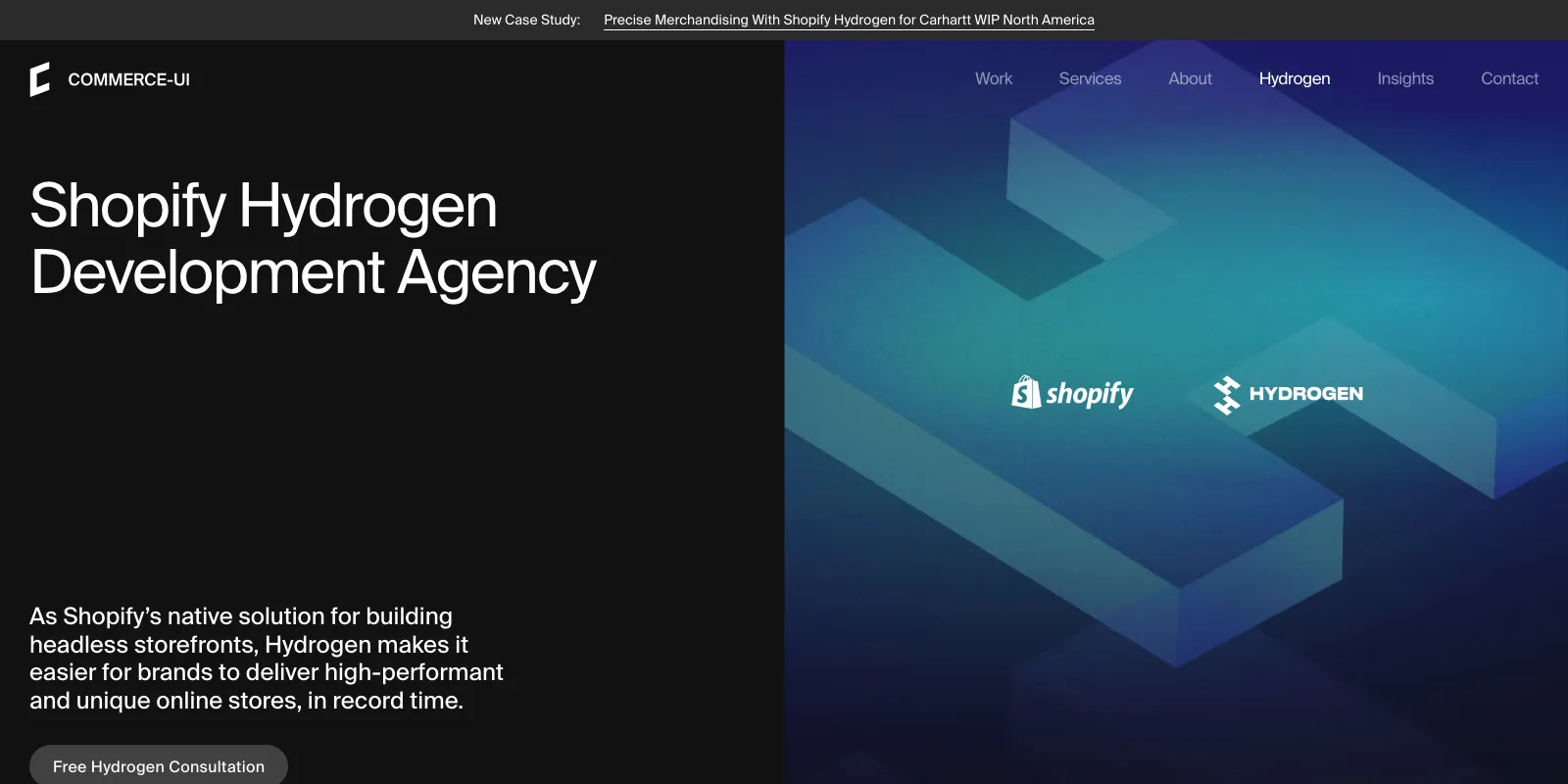
Commerce-UI is a headless commerce studio with a dedicated Shopify Hydrogen practice and a public track record of Hydrogen storefronts for brands like Oura, Aether, Lift Foils, and Nour Hammour. They run a Hydrogen-specific service page, publish Hydrogen case studies with real numbers, and pair Hydrogen with content platforms like Sanity when a brand needs on-brand page building.
What they offer
Shopify Hydrogen consulting and technology evaluation
Custom Hydrogen storefront design and development
Liquid to Hydrogen migration
Magento and Salesforce Commerce to Hydrogen migration
Storefront API and Sanity CMS integration
Shopify Oxygen deployment
I added Commerce-UI to this list because their Hydrogen work is visible and current: the case studies name the framework, the results, and the integrations, which is exactly the kind of proof you should demand from any agency on your shortlist.
Avex Designs - Reliable Shopify Plus Partner
Avex is a Platinum Shopify Plus partner agency based in New York with a clear focus on custom storefronts. Their headless commerce practice names Hydrogen and Oxygen among the platforms they build with for enterprise brands, alongside Sanity and Contentful on the content side. Their team focuses on frontend performance and eCommerce UX, and provides full delivery support.
Their Services Include:
Shopify Hydrogen storefront development
React architecture setup
Headless Shopify structure planning
Storefront API integration
GraphQL query configuration
Shopify Oxygen deployment
I added Avex Designs to this list because they are one of the few boutique Shopify Plus agencies that name Hydrogen and Oxygen in their headless offering rather than stopping at themes. Their team works closely with brands that care about design, performance, and modern technology choices.
Of course, you can also do your own research and look for an agency that fits your specific needs. Just make sure they actually understand Hydrogen and have real projects to show for it.
In the next section, we'll break down where to find and compare Shopify Hydrogen agencies step by step.
Option #2: Use Review Platform Filters to Hire Shopify Hydrogen Developers
Another great way to hire a Shopify Hydrogen developer is by using review and rating platforms like Clutch, where you can compare hundreds of vetted development agencies. These platforms let you browse verified reviews, portfolios, and technical expertise so you can quickly narrow down your options based on what matters most for your project.
Hiring through a rating platform is especially useful when you want to skip the trial and error and go straight to agencies that have already delivered Hydrogen work in the past.
How to Hire Shopify Hydrogen Developers Using Clutch
2. Search for "Shopify Hydrogen" or "Headless Shopify" and open the list of relevant development agencies.
3. Use filters to refine your search
Location
— Filter by regions that match your budget and timezone. Eastern Europe and Latin America often offer a good balance between quality and cost.
Hourly rate
— Pick a range that fits your budget. For Hydrogen work, the sweet spot is usually $50 to $149 per hour.
Company size
— Choose whether you prefer working with a small, focused team or a larger agency with broader coverage.
Project size
— Filter by minimum project budget. Hydrogen storefronts are usually not low-cost, so narrow down to teams that work with $25k+ budgets.
Ecommerce focus
— Make sure the agency specializes in ecommerce or Shopify work
4. Review agency profiles carefully
Check each profile for:
Client reviews
— Focus on structured feedback. Look for mentions of headless storefronts or performance upgrades.
Case studies
— Search for examples that include Hydrogen custom storefronts or migrations from Liquid.
Technical skills
— Make sure Shopify and React are core competencies and not just listed among 20 frameworks.
Team location
— Confirm timezone overlap and communication expectations.
Portfolio quality
— Pay attention to UX complexity, performance work, and mobile responsiveness.
Avoid agencies that claim to do everything. Instead, focus on those that actively promote Hydrogen services or headless Shopify delivery.
5. Contact the short list
Once you find a good fit, reach out directly through Clutch or the agency website. Include a short brief that covers:
What your store does and what you want to build
Timeline budget and team setup expectations
Whether you need just development or full support, including QA and design
Why Use Clutch to Hire Shopify Hydrogen Developers?
Verified client reviews from real ecommerce teams
Filter by ecommerce focus, headless stack, and region
Detailed company pages with tech skills pricing and case studies
Direct contact options without middlemen
Faster vetting process compared to cold outreach
Platforms like Clutch save time and reduce risk when you use them as research tools rather than just directories. Agencies that specialize in Shopify Hydrogen, like The Frontend Company and others from the previous section, are often listed there with real proof of delivery.
You can also check other B2B platforms like GoodFirms and DesignRush, which have Shopify categories and similar filtering features.
In the next section, we'll cover how to hire Hydrogen developersthrough marketplaces and why that path may not be ideal for most serious builds.
Option #3: Hire Shopify Hydrogen Developers from Freelance Platforms
Another way to hire a Shopify headless developer is through freelance marketplaces. However, I do not recommend this method if your project is complex or long-term.
Freelancers are good for fixing layout bugs, updating product logic, or testing a new feature.
When you are leading a project that requires architectural planning, frontend optimization, and hands-on experience with modern tooling, freelancers often disappear, miss deadlines, or quietly skip hard parts of the work.
But the worst part is that many will lie about what they have done or what resources they actually have. I have seen this happen more than once, even on the most well-known freelance platforms. It leads to wasted time, broken trust, and delays, which I hate most.
An additional disadvantage is that you will have to manage everything on your own, including setting requirements, tracking tasks, testing code, and ensuring it all works in production.
So before choosing this option, ask yourself a few questions:
Are you ready to handle technical quality on your own?
Do you have time to check and validate every task?
Are you okay with the risk of someone disappearing halfway through?
If you still decide to try freelance hiring, here are the most used platforms
Always look closely at the profile. Most freelancers say they work with Shopify, but that usually means Liquid, not Hydrogen. Some even add Hydrogen as a keyword without ever launching a real storefront.
Ask for live examples and check whether they use the Storefront API, GraphQL, and SSR in their code.
For anything serious with Hydrogen, we strongly suggest working with a development agency. But if your budget is tight and the task is short, freelance platforms are not a bad option. Just be ready to stay involved throughout the process and double-check every step.
These are the three main ways to hire Shopify Hydrogen developers. Once you choose the path that fits your needs, the next step is doing it right.
At The Frontend Company, we regularly hire developers for our own team and for our clients' teams, so we know what makes the difference between a smooth process and a painful one.
Keep reading to learn exactly how to hire Hydrogen developers step by step and avoid common traps along the way.
How to Hire Shopify Hydrogen Developers Right in 2026
This section provides a straightforward guide to evaluating and selecting the right agency or talent.
I will explain how we do it at The Frontend Company, as we regularly hire Shopify Hydrogen developers for our own team and for our clients, so we understand what works and what usually goes wrong.
How to Hire a Shopify Hydrogen Agency (And What Should You Ask Them About?)
Let's explore how you can hire an Agency for your Hydrogen project step by step.
1. Reach out to an agency that knows Hydrogen
When you find an agency that offers Hydrogen services, send them a message and book an introduction call.
At The Frontend Company, we usually start with an intro call where I and our HR lead ask about your goals, the kind of store you want to build, and the results you expect. After that, we explain the best way to do it, how long it will take, and what the team will look like.
2. Ask the right questions
This first call is your chance to understand if the agency actually knows what they are doing. Here are a few questions you should ask, and what the answers will tell you:
1. Have you built a live Hydrogen storefront?
This tells you if they have real project experience or just general knowledge.
2. How do you handle routing, loaders, and server-side rendering in Hydrogen on React Router 7?
If they explain it clearly, with structure and examples, that is a good sign. If they only talk in Remix-era terms, their Hydrogen experience predates the current framework.
3. Do you have React and GraphQL developers on your team?
These skills are essential for Hydrogen. The team needs to know both.
4. How do you manage migrations from Liquid to Hydrogen?
A good agency will have a clear and tested process for that.
5. Who exactly will be on the project?
You should know if you are working with senior engineers or not.
6. How deep does your Storefront API work go: cart, customer accounts, metafields, typed GraphQL queries?
Hydrogen generates TypeScript types for Storefront API and Customer Account API queries. A team that has used them will mention it without prompting; a team that has only fetched a product list has not built a storefront.
7. Where do you deploy, Oxygen or self-hosted, and how do you handle caching, environments, and preview deployments there?
Oxygen cache rules, environment variables, and per-commit previews are day-to-day Hydrogen work. If nobody on the team has shipped to Oxygen, or consciously chosen another runtime, they have not taken a Hydrogen project all the way to production.
If the answers are clear and honest, and the team seems open and confident, that's a strong signal.
3. Start working together
If you feel good about the call and the agency answered all your questions clearly, you can hire them. Most agencies will send you a short proposal with project scope, timeline, and pricing. From there, you can sign and get started.
Good communication and a good feeling during the calls are more important than any marketing on their website.
How to Hire a Shopify Hydrogen Freelancer
If you still want to hire a freelancer for a Hydrogen project, here's how to do it right. Just keep in mind that this option is risky, especially if your project is anything more than a small fix or experiment.
1. Search on freelance platforms
Start by checking platforms like Upwork, Fiverr, or PeoplePerHour. You'll find many profiles that mention Shopify and even Hydrogen. But it's hard to know who actually has proven experience and the necessary skills.
2. Get on a call and pay attention
Talk to them directly and ask them the following questions:
1. Can you show a live Hydrogen storefront you built?
This helps you confirm they've worked on a real project and not just followed a tutorial.
2. What parts of the project were your responsibility?
If they handled architecture, routing, or performance, that's a good sign. If they just fixed styles or made tweaks, it's not enough.
3. How do you handle routing and server-side rendering in Hydrogen on React Router 7?
Their answer shows if they actually understand the core framework or just used a boilerplate.
4. Have you used Storefront API and GraphQL directly?
Hydrogen relies on these tools. If they can't explain how they used them, it's a red flag.
5. What tools do you use for testing and QA?
This gives you a sense of their attention to quality. No testing usually means fragile code.
6. How do you report progress and share updates?
If their process is unclear, expect lots of chasing and misunderstandings during the build.
7. What timezone are you in, and when do you usually work?
If you can never talk in real time, small issues turn into long delays.
8. Have you deployed a Hydrogen storefront to Oxygen yourself?
If the answer is no, they have never carried a Hydrogen project through to production, whatever the profile says.
If they can't explain it clearly or sound unsure, it's better to keep looking.
And if we speak clearly, this whole process is a massive headache. It is so useless to waste time managing tasks that should not be your job in the first place.
Some platforms pay freelancers very little but charge you two or three times more, so you end up overpaying and rolling the dice.
I could write ten more pages about why this model fails for serious Shopify Hydrogen work, but here's the short version.
If you want results, work with an agency. You'll save time, avoid stress, and actually get what you paid for.
How Much Does It Cost to Hire Shopify Hydrogen Developers
Let's talk numbers. How much should you budget to hire Shopify Hydrogen developers in 2026? The cost can vary dramatically based on region, experience level, and hiring model.
Below, I'll break down typical rate ranges and project costs, along with the key factors that drive them. Use this as a rough guide to plan your budget.
Hourly Rates and Salaries by Region
Region
Hourly Rate Range
Notes
North America
$75–$150+
Senior Hydrogen devs. High salaries but top talent.
Western Europe
$70–$140
Similar to the US for niche skills.
Eastern Europe
$40–$95
Great value, strong dev pool, timezone-friendly.
Asia
$15–$90
Wide range. Top devs charge more.
Latin America
$25–$70
Good mix of price and time zone for US-based teams.
Common Engagement Models and Price Ranges
Small project / MVP
Basic Hydrogen demo or storefront: $5k–$10k
Mid-sized build
Headless setup with a few integrations: $20k–$50k
Enterprise project
Full-scale storefront, custom design, systems integrations: $50k–$150k+
Ongoing support
Monthly retainers for support or iteration: $2k–$10k/month
Dedicated Shopify Hydrogen developers
Monthly per-developer rate, usually derived from the regional hourly ranges above. The best fit for ongoing storefront work, where a fresh per-project quote every month would cost more than keeping people who already know the codebase.
What Affects the Price?
Here's what can drive your cost up or down:
1. Experience level
Senior devs are faster, better, and more expensive, but often worth it.
2. Project complexity
More pages, custom design, and advanced features = more hours.
3. Integrations
Extra tools like CMS, ERP, reviews, or multi-language setup require extra work.
4. Design/UI polish
If your store needs custom design or animations, it takes more time.
5. Timeline
Rushed projects cost more. Plan ahead to keep budgets realistic.
6. Support after launch
Some teams charge ongoing fees for bug fixes and feature updates.
Why Agencies Often Save Money in the Long Run
The best headless Shopify agencies, like TFC, offer fixed estimates based on your scope of work. You know the timeline, the cost, and who you're working with. Freelancers or random devs might look cheaper on paper, but delays, mistakes, or rewrites can wipe out any savings.
In the end, when you work with an agency, you don't pay for hours. You pay for outcomes.
Challenges When Hiring Shopify Hydrogen Developers (With Best Practices)
I think you've realized by now that hiring Shopify headless developers or an agency isn't easy. But don't worry — every problem has a solution, and the key is to prepare well for the challenges ahead. Here are the main ones and how to deal with them.
1. Confusion Between Liquid and Hydrogen Skills
A common hiring challenge is accidentally hiring a general Shopify developer who doesn't actually know Hydrogen. Shopify's ecosystem has thousands of developers proficient in Liquid, but building a Liquid theme requires a very different skill set from building a Hydrogen app.
Companies sometimes assume any Shopify expert can "figure out" Hydrogen, and that's not always true. We've seen cases where a hire claimed Shopify expertise and then struggled with React and API usage in a headless context.
Best practice: Test specifically for headless knowledge. In interviews, include a few technical questions that only a headless-savvy dev would know. If they can't clearly answer how Hydrogen works or stumble on React questions, they might not be the right fit for your project.
2. Architectural and Performance Issues in Early Builds
Let's say you find a developer who's a decent React coder, but maybe it's their first or second Hydrogen project. One challenge that arises is suboptimal architecture – perhaps they don't structure the app well for scalability, or they ignore certain best practices, leading to performance issues.
Best practice: Insist on code reviews or audits during the project. If you're not technical, consider bringing in a consultant or asking the agency (if you hired one) to do an architecture review at milestones.
If hiring a freelancer or a new in-house dev, arrange a third-party code audit midway. Basically, trust but verify – even a good developer can make suboptimal choices if they're a bit green in headless, so bake in oversight.
3. Communication Problems in Remote Teams
You could be hiring remotely or working with an overseas team. Communication challenges can arise from time zone differences, language barriers, or simply misaligned expectations.
Best practice: Establish a communication cadence and tools from the start. Treat your hiring choice as part of the team – use project management tools that clearly describe tasks and log progress. Have regular check-ins to stay in sync, especially across time zones.
If working with an agency, ensure there is a single point of contact who is responsive. You want transparency – a good sign is an agency that speaks clearly about timelines and issues from day one.
4. Post-launch Ownership and Support
One more challenge is figuring out who owns the product after its release. If you hired an external party to build your Hydrogen store and then part ways right after launch, you might find yourself without anyone to handle issues or do enhancements.
Best practice: Plan for maintenance from the outset. If you engage an agency, strongly consider a maintenance retainer with them for a period after launch, or at least an extended support window. Many agencies include 30-90 days of post-launch support for bug fixes.
The goal is to avoid the "nobody knows how this thing works" scenario.
Common Mistakes When Hiring Shopify Hydrogen Developers
Lastly, let's go through the most common mistakes from our own experience as an agency and from our clients' hiring processes. We've collected the key ones you really need to avoid if you want a smooth and successful hiring process.
1. Choosing a developer (or agency) based solely on the lowest price
Picking a developer or agency only because they offer the lowest price is a common mistake. Cheap usually means less experience, lower quality, and more problems later.
You might save a bit at first, but end up spending more fixing things. It's better to pay more for someone who actually knows what they're doing.
2. Skipping a technical screening or proper portfolio review
Even if you're not technical, it's a big mistake to hire someone just because they sound good on a call or have a nice resume. You need to make sure they can really build what you need.
It doesn't mean doing hard tests. Just ask for code examples or give them a small tech task. Skipping this step often leads to problems later.
3. Not clearly defining the project scope and responsibilities
If you go into hiring without a clear idea of what you want the developer to do, you can end up with misaligned expectations. For instance, you hire a developer thinking they'll "handle everything", but they expect you to provide a complete API or design.
Always write down what needs to be done and who does what — it saves time, money, and stress later.
4. Ignoring communication and work style
Even if someone is great at coding, it won't help if they never give updates or work in a way that clashes with your team. If they miss deadlines or go silent, it creates problems. Always check how they communicate and if their style fits yours.
5. Only checking technical skills, not problem-solving
A developer might know all the right tools but freeze when something unexpected happens. Ask how they solve problems or handle tricky situations. You want to hire a developer who can figure things out and be proactive, not just follow instructions.
Conclusion
There are several ways to hire Shopify Hydrogen developers — from freelance platforms to review sites to specialized agencies. Each option has its strengths, but also its limitations. Your final choice should depend on the size of your project, your timeline, and the level of risk you're willing to take on.
If you're building something serious, working with a dedicated agency is the safest and most effective route. You get a full team, a straightforward process, and accountability from day one.
At The Frontend Company, Shopify Hydrogen is one of our core services. We've helped over 100 businesses launch high-performing headless storefronts, and we know how to navigate the challenges that come with them.
If you're looking for a team that understands Hydrogen inside and out, feel free to book a call with us. We'll help you figure out the best path forward and make sure your project starts on the right foot.
It is technically possible, but not something you should rely on if your project is serious. Hydrogen is a completely different tech stack based on React, server-side rendering, and API integration. A developer used to working with Liquid templates may struggle with component-based architecture or GraphQL queries. If you want fast results and production-quality code, it is much safer to hire someone with real Hydrogen experience from the beginning.
For most Hydrogen projects, a strong frontend developer is more valuable than a generalist. Hydrogen development is all about building high-performing, interactive storefronts using React, TypeScript, and the Storefront API. A backend developer might not have the skills to handle UI state, routing, accessibility, or performance optimizations. If you already have a backend or Shopify setup, prioritize frontend expertise.
If your project is very small or experimental, hiring one developer could work. But for any real storefront that needs to be fast, scalable, and user-friendly, one person is usually not enough. You will need UI/UX input, testing, performance checks, and someone to manage progress. Most failed projects we’ve seen started with one developer doing everything and eventually running into quality or delivery problems. It is better to work with a small focused team.
That depends on your timeline and risk tolerance. If you are okay with delays and extra costs for onboarding and mistakes, you could take that approach. But Hydrogen involves concepts like Shopify's APIs, React Router 7 loaders, edge rendering with Oxygen, and eCommerce performance tuning that even good React developers might not know. If the work needs to be done right and on schedule, hiring someone who already understands the Hydrogen ecosystem is a better option.
The best way to find out is to ask for a live Shopify Hydrogen project they have worked on. Ask them to explain what they built, how they structured the code, and how they used the Storefront API or handled routing. If their answers are vague, generic, or full of buzzwords without substance, they probably do not have real experience. Real Hydrogen developers will confidently explain their approach and what worked or didn’t work in past projects.
Budget for Hydrogen as senior React work with commerce context on top, not as regular Shopify theme work. Hourly rates follow the regional ranges in the table above, from roughly $40–$95 in Eastern Europe to $75–$150+ in North America, and a full custom storefront typically lands between $20k and $150k depending on integrations and design. For ongoing storefront work, dedicated developers on a monthly basis usually cost less than a chain of per-project quotes, because you stop paying for re-onboarding. We don't publish our own rates; book a call and we'll give you a scoped estimate for your store.
If a customized theme meets your conversion and performance goals, stay on themes: they are cheaper to build, cheaper to staff, and Shopify maintains most of the plumbing for you. Hydrogen pays off when you need full frontend control, custom UX that a theme cannot express, or multi-channel content from a headless CMS. It is an engineering investment with an ongoing maintenance cost, not an upgrade button, so decide based on the business case, not the technology.
Alex Vasylenko is the founder of The Frontend Company, DBC and several other successful startups. A dynamic tech entrepreneur, he began his career as a frontend developer at Deloitte and Scandinavia's largest banking company. In 2023, Alex was honored as one of 'Top 10 Emerging Entrepreneurs' by USA Today.
Alex Vasylenko is the founder of The Frontend Company, DBC and several other successful startups. A dynamic tech entrepreneur, he began his career as a frontend developer at Deloitte and Scandinavia's largest banking company. In 2023, Alex was honored as one of 'Top 10 Emerging Entrepreneurs' by USA Today.
Pavlo runs operations and delivery at The Frontend Company and builds its internal AI systems - agent workflows, automation, and the engineering side of software compliance.