A headless ecommerce agency decouples your storefront from your commerce engine: it builds a fast frontend (usually Next.js or Shopify Hydrogen), connects it to Shopify, BigCommerce or commercetools over APIs, and wires in the CMS, search and integrations a monolithic theme can't. Below: 10 agencies compared, when you actually need one, and what to ask on the first call.
Every agency below names headless or composable commerce as a service on its own site, has a public headless storefront case, and has verified Clutch reviews; the criteria are spelled out in the how-to-choose section.
Headless ecommerce agency comparison: which 10 made the 2026 list?
One row per agency, The Frontend Company first. Platforms are the commerce engines each agency names on its own site; Clutch ratings were checked on 28 October 2026.
Agency
Best for
Platforms
Key strength
Clutch rating
The Frontend Company
Stores where every release breaks something and marketing waits on developers
Shopify Plus, BigCommerce, custom backends
Storefront, CMS layer and integrations built by one frontend-first team
5.0 (30 reviews)
Commerce-UI
Design-led Shopify Plus brands going headless on Hydrogen
Shopify Plus
Shopify Build Award for Best Hydrogen Storefront, Sanity editorial workflows
5.0 (15)
Naturaily
Shopify stores that need the CMS and the storefront from one team
Shopify Plus
Certified Shopify, Sanity, Storyblok and Vercel partner
4.9 (37)
Elogic Commerce
Enterprise and B2B replatforming across several engines
Adobe Commerce, BigCommerce, commercetools, Medusa.js, Salesforce, SAP, Shopify Plus
Dedicated commercetools practice, $10,000 entry point
4.9 (32)
Domaine
Enterprise fashion and beauty brands committed to Shopify
Shopify Plus
Shopify Platinum Partner, headless and theme migrations in both directions
5.0 (2)
Aureate Labs
Cost-conscious Shopify or Magento stores wanting a PWA storefront
Adobe Commerce, Shopify Plus
Alokai and Hyvä partner at offshore rates
4.9 (30)
1. The Frontend Company
The Frontend Company is a headless ecommerce agency for brands whose store breaks after every release and whose marketing team can't launch a campaign without a developer. We build the storefront, connect it to your commerce engine and CMS, and stay on after launch so the setup keeps working as the catalog and the team grow.
What we build: storefront frontends on Next.js and Shopify Hydrogen, platform integration with Shopify Plus, BigCommerce or a custom backend, the CMS layer on top, performance optimization, API integration and ongoing support. The full scope is on our headless commerce development services page.
CMS layer, in alphabetical order:Contentful, Payload, Sanity and Storyblok. We pick per client, not per habit; Payload is the natural fit when the storefront is already a Next.js app, Contentful or Sanity when an editorial team needs workflows and localization.
Proof rather than adjectives: over 100 complex headless builds, a 5.0 rating from 30 reviews on Clutch, and our own website runs on a headless setup, so the handoff problems this list talks about are ones we deal with every week.
Why we put ourselves first:
Frontend is the whole business. React and Next.js are what we do all day, so the storefront is not an afterthought bolted onto a platform project.
We start with the release process, not the framework. The first call is about what breaks, how often you ship and who waits on whom; the stack comes after.
We say no when headless is not the answer. A fast theme and a cleaner integration layer sometimes beat a replatform, and we'll tell you that on the first call.
Direct access. You talk to the engineers building your storefront, and Alex, our CEO, joins the key calls.
Is your store outgrowing its platform?
Book an intro call - we'll look at your storefront, your integrations and your release process and tell you plainly whether headless is the next move.
2. Commerce-UI
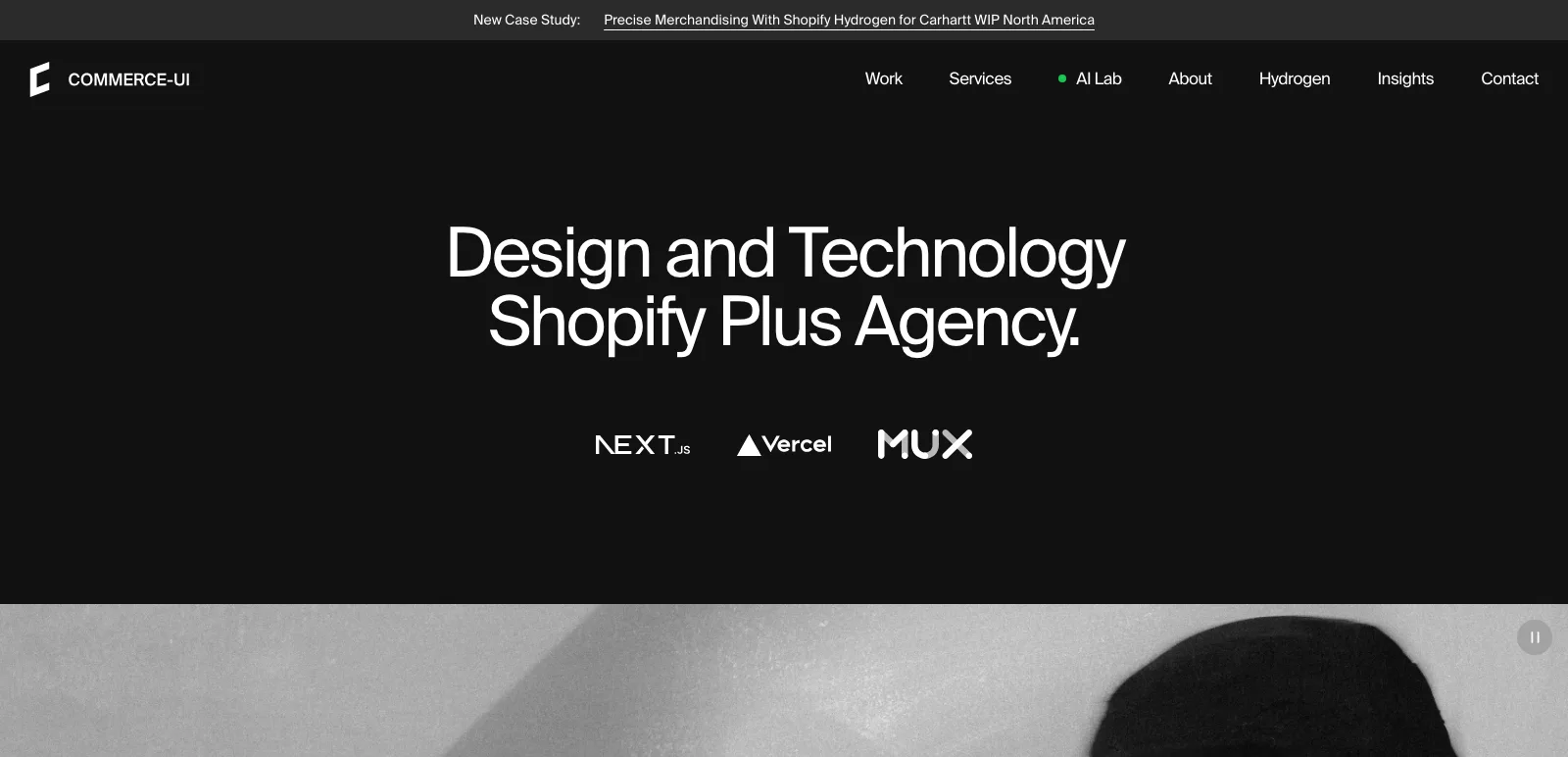
Commerce-UI is a design and technology Shopify Plus agency from Gdańsk, Poland, and the most Hydrogen-focused team on this list. Its build service names headless architecture, Next.js, Hydrogen, Online Store 2.0, checkout extensions and custom API integrations, with Sanity, Vercel and Mux as the usual companions, and it holds a Shopify Build Award for Best Hydrogen Storefront. Clutch shows a 5.0 rating from 15 reviews and a $25,000 minimum. The portfolio is fashion and lifestyle heavy: Carhartt WIP, Magda Butrym, Aether Apparel.
Core services:
Headless Shopify Plus storefronts on Hydrogen or Next.js, hosted on Oxygen or Vercel
Sanity content modeling, editorial previews and scheduled releases
UX and performance audits, A/B testing and analytics integrations
Biggest limitation: Shopify only, and deliberately small. If your engine is BigCommerce or commercetools, or you need a large team for a multi-brand program, look further down the list.
Naturaily is a Wrocław agency with 13+ years and 200+ projects behind it, split between headless CMS and headless commerce. On the commerce side it is a certified Shopify partner with named Shopify Plus, Shopify app and migration services, and the CMS layer comes from Payload, Sanity, Storyblok or Strapi, with Next.js on the frontend. Clutch shows a 4.9 rating from 37 reviews and a $25,000 minimum. A good fit when the same team should own both the store and the content platform.
Core services:
Shopify and Shopify Plus development, migrations and app integrations
Headless storefronts on Next.js connected to Shopify and a headless CMS
Multi-store and multi-market setups with subscriptions and custom cart logic
Biggest limitation: Shopify is the only commerce engine named on its site; BigCommerce, commercetools and Medusa are absent. Teams on those platforms will want a different partner.
Elogic Commerce is a Tallinn-based ecommerce engineering company founded in 2009 with 200+ specialists and 500+ projects. Headless and composable commerce is a named service, and the partner list is the widest here: Adobe Silver Solution Partner, Shopify Plus Partner, certified BigCommerce partner, Salesforce Select Partner, SAP Commerce Cloud partner and commercetools registered partner with 15 certified engineers, plus Medusa.js for custom builds. Clutch shows a 5.0 rating from 65 reviews. Its own guidance is that mid-market headless builds take four to eight months and enterprise ones eight to fourteen.
Core services:
Headless and composable storefronts on commercetools, Medusa.js, Shopify Plus or BigCommerce, with React, Next.js or Vue frontends
Replatforming off Adobe Commerce, Salesforce Commerce Cloud and other monoliths
B2B portals with ERP, PIM and SAP integrations
Biggest limitation: Elogic is built for enterprise programs with a $25,000 minimum on Clutch and a $50,000 minimum on its own headless page. A small DTC store will find the process heavier than it needs.
Highlighted case:Elogic built a wholesale portal for PetHQ for 1,400+ B2B users that went live in 2.5 months and, per the agency, brought $1.1M in new B2B revenue in year one; its headless page also lists a PWA storefront for a beauty marketplace on a Salesforce Commerce Cloud backend.
5. Divante
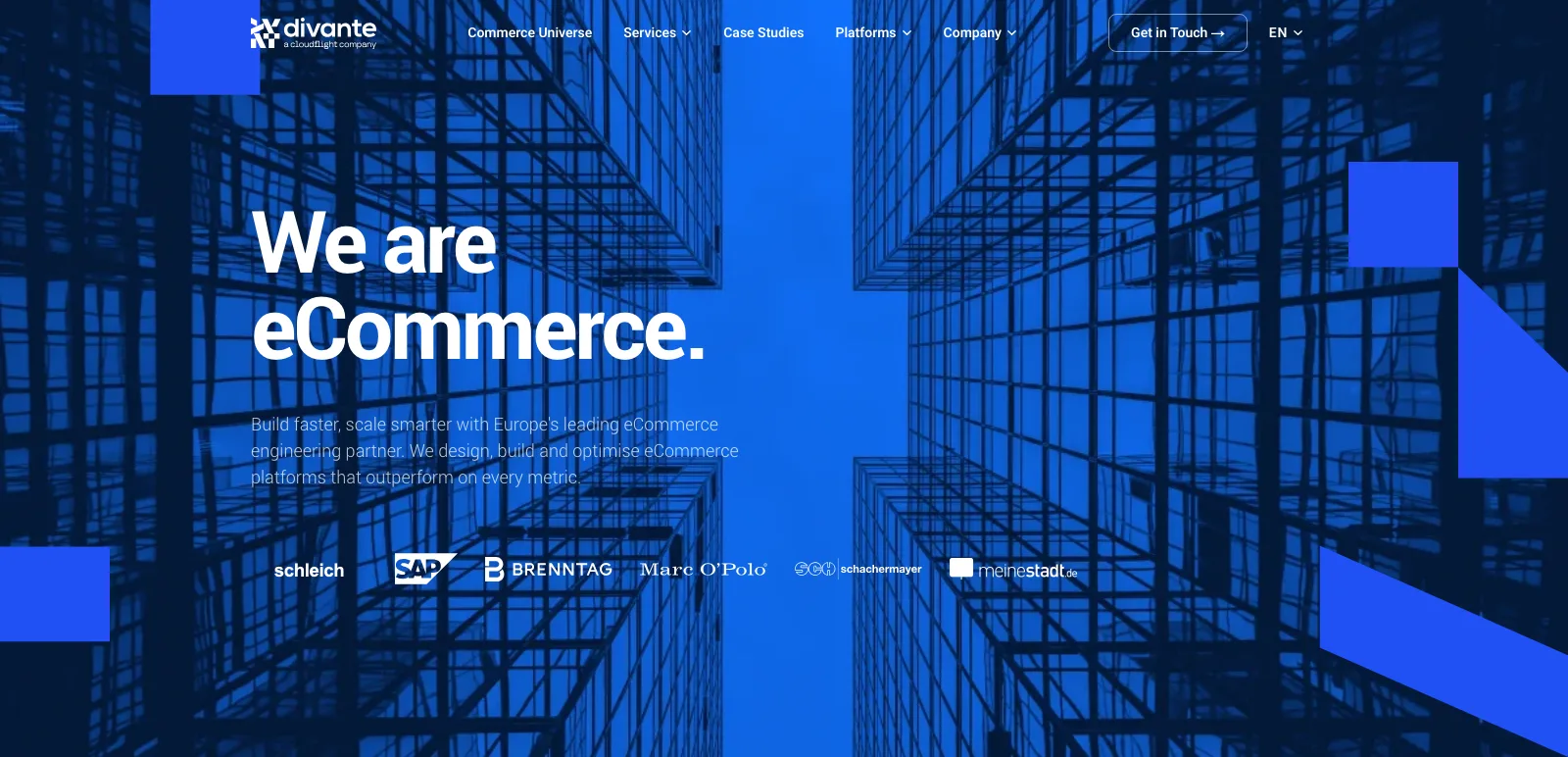
Divante is the Wrocław company that originally created Vue Storefront, now Alokai, and today part of the Cloudflight group; it still sells headless storefronts and composable commerce as headline services. Platforms named on its site are Shopify Plus, commercetools, Alokai, Medusa, BigCommerce and Adobe Commerce, with 18+ years in ecommerce, 250+ projects and a claimed 1,000+ specialists worldwide. Clutch shows a 4.6 rating from 17 reviews and a $50,000 minimum. Choose Divante when the project is a multi-market enterprise storefront with a PIM, an OMS and a search engine to orchestrate.
Core services:
Headless storefronts on Alokai, Next.js or Vue, decoupled from the commerce backend
Composable commerce architecture and migrations off monolithic platforms
Search, recommendations and catalog work for very large product ranges
Biggest limitation: Scale cuts both ways: a group with hundreds of engineers brings process, management layers and enterprise pricing, and the Clutch rating is the lowest on this list. Mid-size brands will feel the overhead.
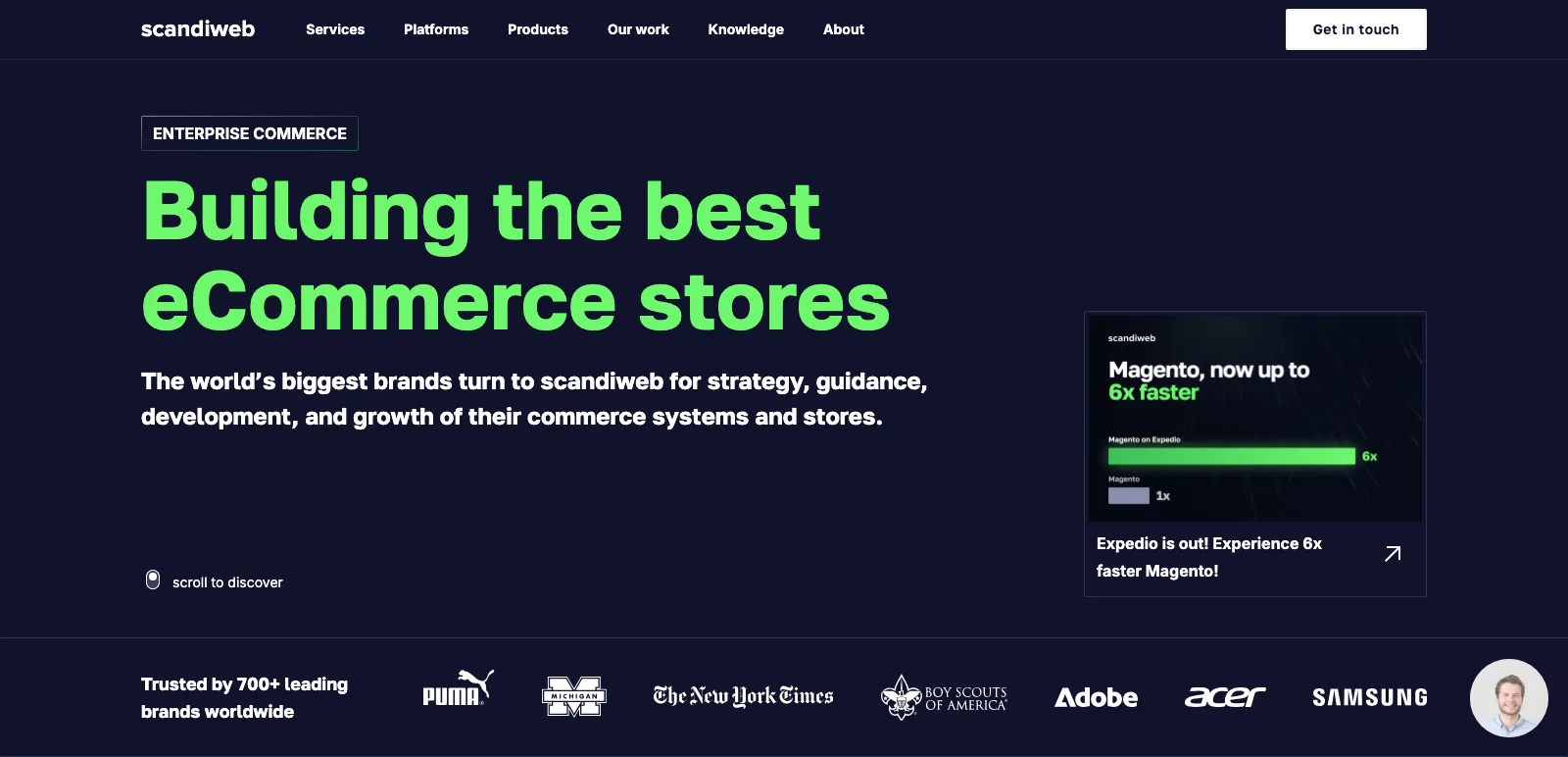
Scandiweb is the team behind ScandiPWA, the open-source headless frontend for Magento that its site says runs in production for 500+ brands. Its headless commerce service covers Adobe Commerce with a React or Hyvä frontend, Shopify Plus with Hydrogen or a custom React storefront on the Storefront API, and BigCommerce over the GraphQL Storefront API. The company claims 600+ specialists across 45 countries, 700+ clients, Adobe Commerce Gold and Hyvä Platinum partner status. Clutch shows a 4.8 rating from 53 reviews and a $25,000 minimum.
Core services:
Headless storefronts for Adobe Commerce, Shopify Plus and BigCommerce
Staged migrations off monolithic platforms with search, payment, PIM and ERP integrations
Multi-store and B2B headless setups, then post-launch optimization
Biggest limitation: The roots are Magento. If your world is Shopify Hydrogen or commercetools only, a specialist will be closer to your stack, and a 600-person company is not the place for a two-sprint job.
Highlighted case:Scandiweb's headless commerce page reports four new PUMA markets launched in 95 days with 3x better performance and 5,000+ orders in the first months, and +148% mobile revenue and +73% add-to-cart rate for Cervera after a single-page-application rebuild.
7. Orium
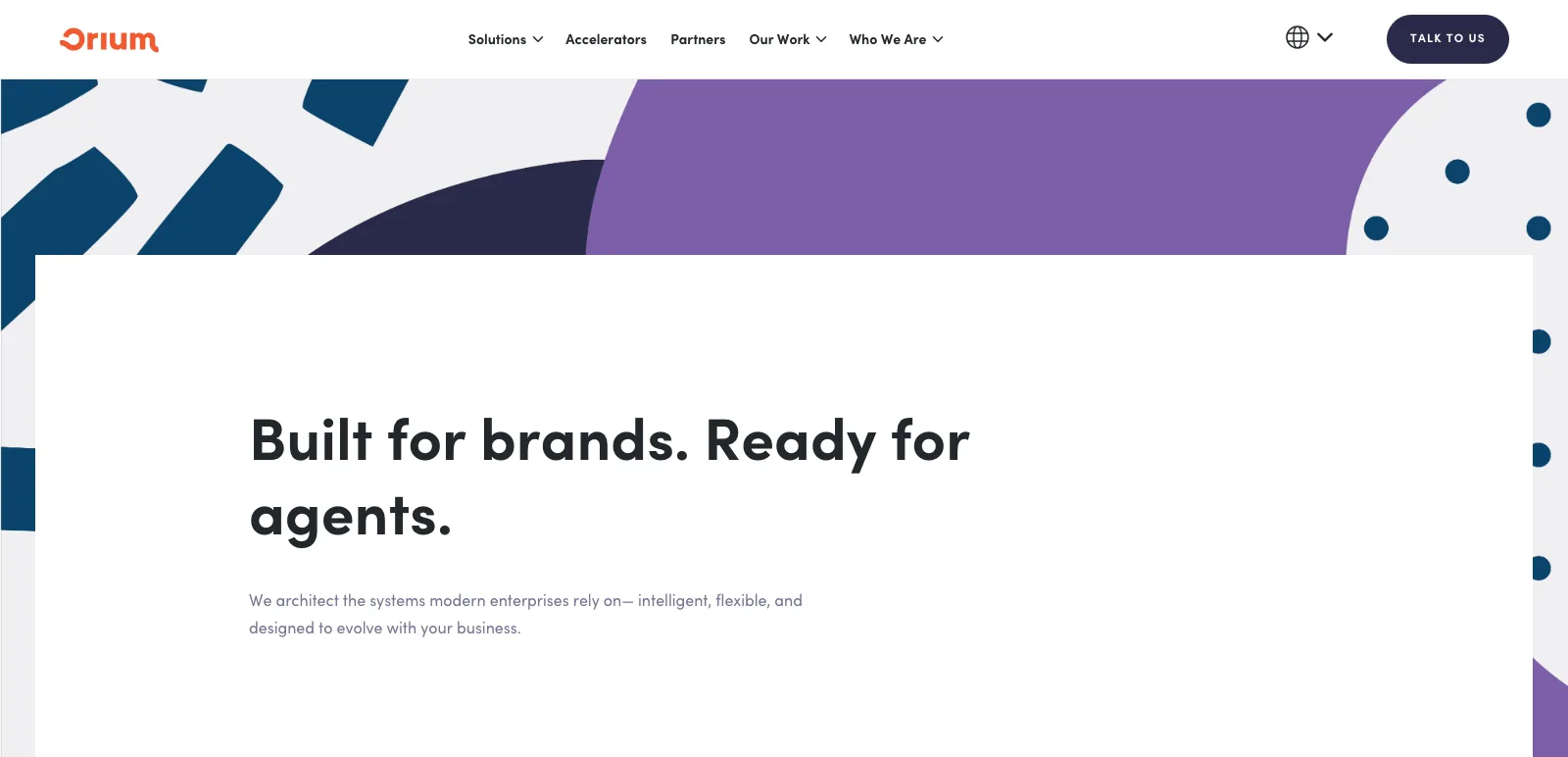
Orium is a Toronto commerce consultancy and systems integrator, with offices in Chicago, Vancouver and London, that works almost exclusively in composable architecture for enterprise retailers. Its partner page lists commercetools, Shopify, Commerce Layer, Fluent Commerce, Contentful, Contentstack, Algolia, Vercel and Netlify, and the company is a MACH Alliance certified SI. Clutch shows a 4.8 rating from 12 reviews, a $100,000 minimum and $150 to $199 hourly rates. The language on its site is composable rather than headless, but the work is the same: storefront, content and search decoupled from the commerce engine.
Core services:
Composable commerce migrations off legacy platforms such as Oracle ATG or Salesforce
commercetools implementations with Contentful or Contentstack and Algolia
Order management, loyalty and data integration across the stack
Biggest limitation: Enterprise only. The $100,000 minimum and the phased-program style rule out mid-market brands, and its published case studies describe outcomes without hard numbers.
Highlighted case:Orium moved Destination XL, a US retailer with 290 stores, off Oracle ATG in three phases: Contentstack pages first, an event-driven data layer with Algolia second, and cart, checkout, payments and loyalty on commercetools last, so the legacy platform could be retired without a big-bang cutover.
8. Dinarys
Dinarys is an ecommerce development company with offices in Berlin and Santa Clara and engineering in Dnipro and Kraków, 12 years on the market and 431+ delivered projects by its own count. Composable commerce is a named service group with consulting, solution development and migration, and there is a dedicated commercetools development page next to Adobe Commerce, Shopware, Shopify, BigCommerce and Salesforce Commerce Cloud. Clutch shows a 4.9 rating from 32 reviews and a $10,000 minimum, the lowest entry point on this list for a composable-capable team.
Core services:
Composable commerce consulting, development and migration on commercetools
Adobe Commerce, Shopify, BigCommerce and Shopware builds and replatforming
DevOps, hosting and performance work for the backend side of the store
Biggest limitation: Its site talks composable rather than headless and the published case studies, such as the ModaMatrix BigCommerce store or the MedExcess marketplace, do not report numbers. Ask for a reference storefront before signing.
Highlighted case:Dinarys built ModaMatrix, a BigCommerce fashion store with third-party integrations, cross-channel selling and a loyalty system, and a multi-vendor medical marketplace for MedExcess built to PCI DSS, HIPAA and GDPR requirements; neither case publishes performance figures.
9. Domaine
Domaine is a Shopify Platinum Partner headquartered in New York with 300+ full-time staff that works only on Shopify. It absorbed Half Helix, the Hydrogen agency whose site now redirects to Domaine, and its service list names Headless Development plus migrations in both directions: Shopify theme to headless and headless back to a theme. The site cites 750+ Shopify sites launched, 150+ migrations to Shopify and a Q3 2026 with 18 launches, including M.A.C., Clinique and Alexander Wang. Clutch shows a 5.0 rating from only 2 reviews, so rely on the published client list rather than the score.
Core services:
Headless Shopify storefront development and theme-to-headless migrations
Replatforming to Shopify from Salesforce, Adobe Commerce, BigCommerce and Sitecore
Design systems, ERP integrations, internationalization and B2B on Shopify
Biggest limitation: Shopify only, enterprise-brand pricing, and no headless case study with published numbers. The two-direction migration offer is also a tell: Domaine will move you back to a theme if headless is not paying off, which is honest but means it is not a headless-at-all-costs shop.
Highlighted case:Domaine replatformed Pro:Direct Sport from Sitecore to Shopify, listed on its services page next to launches for Timex, Arhaus and Ulla Johnson; the agency reports an average 19 to 29 percent conversion-rate lift across its migrations but does not break it out per project.
10. Aureate Labs
Aureate Labs is a Shopify Plus and Adobe Commerce agency headquartered in Surat, India, with a US office, and the only offshore-priced team on this list: Clutch shows a 4.9 rating from 30 reviews, a $10,000 minimum and $25 to $49 hourly rates. Headless work sits inside the store development service as Alokai (formerly Vue Storefront) storefronts, Shogun Frontend for Shopify and Hyvä themes for Magento, with Adobe Commerce, Vue Storefront, Hyvä Gold and Shogun partner badges. The site claims 400+ stores and 95% client retention.
Core services:
Headless PWA storefronts on Alokai over Shopify or Adobe Commerce
Shopify Plus and Magento store development, migrations and performance optimization
Hyvä and Shogun frontends when a full headless build is more than the brand needs
Biggest limitation: Headless is one option in a wider theme and performance catalog rather than the main business, and its headless case studies publish no numbers. Time-zone overlap with US and EU teams needs to be agreed up front.
Highlighted case:Aureate Labs built a headless PWA for Miko, a consumer-robotics brand selling in India, the US and South Africa, on Alokai over Shopify with Contentful for geo-specific content and Chargebee for subscriptions, so one storefront serves each market in its own language and currency.
Need an honest answer about your headless commerce setup?
Book a call with our team - we look at your storefront, your integrations and your release process together and tell you whether going headless will pay off or whether a simpler fix will do.
When do you actually need a headless commerce agency?
Headless is a move you make when the store grows faster than the platform underneath it, not because it is trendy. Five situations where bringing in an agency makes sense:
Page speed is costing conversions. Multi-second loads and conversion drops after traffic spikes mean the theme has hit its limit; a decoupled, server-rendered storefront takes the load off the platform and gets pages in front of users and crawlers faster.
Every content change needs a developer. When a landing page or a product section waits for a sprint, marketing stops testing ideas; a headless CMS wired into the storefront lets the team publish and run campaigns on its own.
Design ideas don't fit the template. Standard themes block the layouts and interactions your designers want; a React or Next.js storefront removes that ceiling without plugin conflicts or theme hacks.
Integrations have turned into chaos. CRM, ERP, PIM, analytics and personalization tools stepping on each other is an API orchestration problem, and that is exactly what a headless commerce agency is built to solve.
Scaling feels risky. If each launch, market rollout or sale feels like a potential outage, decoupling the storefront from the engine lets you scale infrastructure and expand into new markets without rewriting the platform every time.
Which stack do headless commerce agencies use?
Most agencies on this list build from the same set of parts. The commerce engine is typically BigCommerce or Shopify with Hydrogen, or, for enterprise and custom-heavy builds, commercetools or Medusa; if you want to staff that layer yourself, see our guide to hire Shopify Hydrogen developers. On top of the engine sits the headless CMS your editors will live in: Contentful, Payload, Sanity and Storyblok come up most often, and the storefront itself is almost always a Next.js app. Our best CMS for Next.js ranking shows how those options compare for that frontend, and the Contentful alternatives guide covers the case where a client has outgrown its pricing tier.
When you vet a headless commerce agency, ask which of these pieces they have shipped together in production. A partner who knows the engine but has never wired it to your CMS will be learning on your project.
How do you choose a headless commerce agency?
Over ten years in frontend development we have built headless setups on Shopify, BigCommerce, custom stacks and API-first CMSs, and the thing we learned is that going headless always looks simpler on slides than in development. The list above was rebuilt from the agencies' own sites in October 2026 against four criteria: headless or composable commerce is a named service, not a line in a long list; the platforms and partnerships are stated, so you can match the agency to your engine; there is a public headless storefront case; and Clutch shows verified reviews, with the count next to every rating in the table. Four agencies from the 2025 list dropped out because they no longer position headless commerce on their own sites, and one could not be re-verified.
Once you have a shortlist, the first conversation tells you the rest. Five things a good headless ecommerce agency does on that call:
It asks about your business before your stack. The first questions should be about what breaks, how your team works and what you are trying to achieve; frameworks and CMS choices come after.
It explains how things will work. Integrations, the staging and release flow, where QA fits, how they communicate. You should leave the call with a clear picture, not a pile of acronyms.
It names the risks. Every serious headless project carries technical risk; an experienced team tells you what can go wrong, which dependencies you will own and how long things really take, and says no when it matters.
It walks you through similar builds. Architecture, the problems solved and the results the client got, not just logos.
It is clear about timeline, cost and team. How they scope, how long each stage takes, who does the work and where the risks sit. If you have to beg for that, keep looking.
If you are weighing an agency against building the team yourself, our guide on how to outsource web development covers the vetting process in more detail.
Conclusion
If you have read this far, your current ecommerce setup is probably reaching its limits: it is slow, your team spends too much time fixing things that should not break, or it simply does not reflect how far the brand has grown. Headless commerce is for teams ready to grow faster and stop depending on templates and plugins that limit progress, and the ten agencies above are the ones we would shortlist for that job in 2026.
Talk to two or three of them, ask the five questions above, and compare the answers. And if you want a straight, honest conversation about whether headless commerce is the right next move for your brand, reach out to us and we will figure it out together.
It decouples your storefront frontend from the commerce backend: the agency designs the architecture, builds a fast frontend (typically Next.js or Hydrogen), connects it to your commerce engine and CMS via APIs, and handles the integrations a monolithic theme can’t.
No. A headless commerce setup is for brands that have already outgrown their platform. If your store runs smoothly, loads fast and supports your goals, you don’t need to change anything yet. Once growth starts exposing limits, that is when headless starts to make sense.
It depends on scope: a storefront built on top of your existing backend costs far less than a full replatform with custom integrations. Most agencies work in fixed-scope phases starting with architecture, so ask for a scoped estimate rather than an hourly guess.
Shopify (with Hydrogen) and BigCommerce cover most mid-market cases; commercetools and Medusa fit enterprise or custom-heavy builds. The CMS layer matters as much as the engine: Contentful, Payload or Sanity depending on your team and stack.
In almost every case, yes. Separating the frontend from the backend lets pages render faster and handle traffic spikes more efficiently. Most brands see faster load times, better Core Web Vitals and improved conversions within weeks after launch.
How do you handle integrations, QA and testing? Who actually writes the code, an in-house team or freelancers? What frameworks do you use and why? How often do you report progress, and what happens if priorities change mid-project? The best agencies answer clearly, stay transparent about budgets and timelines, and start the call by asking about your goals.
If your developers already work comfortably with APIs, React or Next.js, they can probably manage a headless build with the right guidance. If most of their experience is theme customization or plugin work, bring in an experienced partner first and let your team learn alongside them; our comparison of in-house development vs outsourcing covers the trade-offs.
A headless commerce agency owns the store: the storefront, the commerce engine (Shopify, BigCommerce, commercetools) and the integrations around checkout, catalog and orders. A headless CMS agency owns the content platform: content modeling, the CMS (Contentful, Payload, Sanity, Storyblok) and the editorial workflow. If your project is a storefront, start with this list; if it is a content-heavy site or app with no checkout, the headless CMS agency guide linked above is the right one. Many teams, including ours, do both, but the first call should be about the half that hurts most.
We have built headless systems for years and run the same architecture on our own website, so we know how it works in practice. Our focus is frontend development, speed and headless commerce setups on Shopify Plus, BigCommerce and custom backends, with the CMS layer designed together with the storefront rather than bolted on. We tell clients when headless is not the right move, and every store we build is meant to run fast and stay maintainable after we leave.
Alex Vasylenko is the founder of The Frontend Company, DBC and several other successful startups. A dynamic tech entrepreneur, he began his career as a frontend developer at Deloitte and Scandinavia's largest banking company. In 2023, Alex was honored as one of 'Top 10 Emerging Entrepreneurs' by USA Today.
Alex Vasylenko is the founder of The Frontend Company, DBC and several other successful startups. A dynamic tech entrepreneur, he began his career as a frontend developer at Deloitte and Scandinavia's largest banking company. In 2023, Alex was honored as one of 'Top 10 Emerging Entrepreneurs' by USA Today.
Pavlo runs operations and delivery at The Frontend Company and builds its internal AI systems - agent workflows, automation, and the engineering side of software compliance.